Activated carbon for air and gas purification sits at the end of many industrial and municipal processes across the Gulf. A refinery in Ruwais uses it to hold back trace hydrocarbons from a vent header. A wastewater plant in Sharjah uses it to keep odour off the neighbouring district. A biogas facility in Al Ain uses it to protect a combined heat and power engine from siloxanes. The carbon in each of these plants does the same physical thing at the pore level, but the specification that arrives on a purchase order is very different. Bed geometry, pellet size, moisture in the incoming gas, and whether the target molecule reacts with the carbon or only adsorbs onto it, all of these decide which grade fits. Specification decisions arrive in a familiar order for anyone who has sized a gas phase bed before: raw material, physical form, chemistry gate, then bed geometry against the plant fan curve. Working through them in that order is what allows the material that arrives on site to actually match the duty the plant asks it to perform. The underlying physical chemistry, and the way activated carbon holds contaminants at the pore level, gives the background that every specification decision below builds on.
What Makes a Carbon Suitable for Gas Phase Duty
Gas phase adsorption places a set of demands on the carbon that liquid phase duty does not. The molecules of interest arrive in a moving air or gas stream at low concentration, they must be captured before the gas passes through the bed at contact times measured in fractions of a second, and the pressure drop across the bed has to stay within the range the upstream blower or extraction fan was sized for. This shapes the choice of raw material, the choice of particle geometry, and the way the carbon is packed into the vessel.
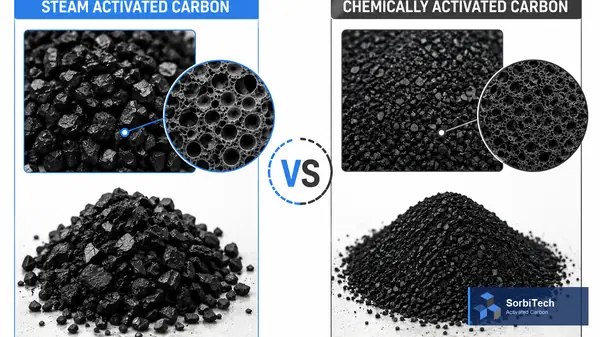
The pore structure most useful for gas phase work is heavily microporous, because most volatile organic and inorganic gas phase target molecules are small. Coconut shell steam activated carbon has this profile in its native state and is the most common raw material stream feeding gas phase grades. Coal based carbon delivers a broader pore distribution and is chosen when the target stream carries a mix of small and mid sized molecules. Chemically activated wood carbon is rarely specified for gas phase duty because its mesopore rich structure gives away micropore capacity that gas phase work needs most.
Pelletised, Granular, or Extruded: Matching Form to the Bed
The physical form of the carbon controls how the gas moves through the bed and how much pressure the fan has to develop. Three physical forms cover almost all gas phase installations. Extruded pellets in 3 mm or 4 mm diameter are the workhorse of large fixed bed vessels, because they give a uniform packed void fraction and the lowest pressure drop per unit of adsorption capacity. Cylindrical pelletised carbon grades for fixed bed vessels are what most gas processing engineers reach for by default when the vessel is large enough that pressure drop dominates the operating cost.
Granular material in 4 by 8, 4 by 10, or 6 by 12 mesh is used in smaller vessels and in scrubber canisters. Granular carbon delivers slightly higher pressure drop for the same bed depth but gives more usable capacity per unit volume, which matters when the bed geometry cannot be extended. For applications such as volatile organic compound abatement in a coating line, the choice between 4 mm pellet and 4 by 10 granular is usually made on the fan curve and the vessel dimensions the plant already has installed, not on the carbon capacity alone.
Powdered carbon has almost no place in a gas phase installation. The particle size is too fine to hold in a packed bed without excessive pressure drop, and the collection of loaded powder from an exhaust stream is a separate mechanical problem. Where a fine adsorbent is genuinely needed in a gas stream, it is delivered on a mineral substrate rather than as a free powder.
When Physical Adsorption Is Enough, and When Impregnation Is Required
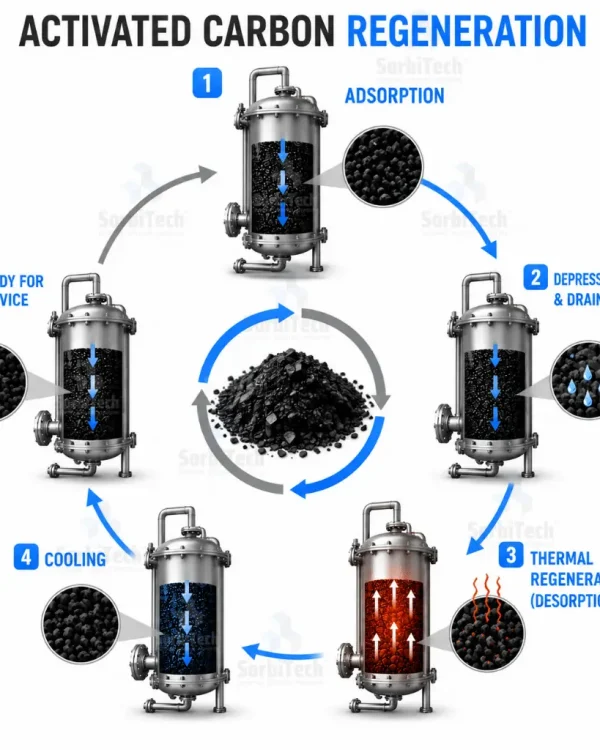
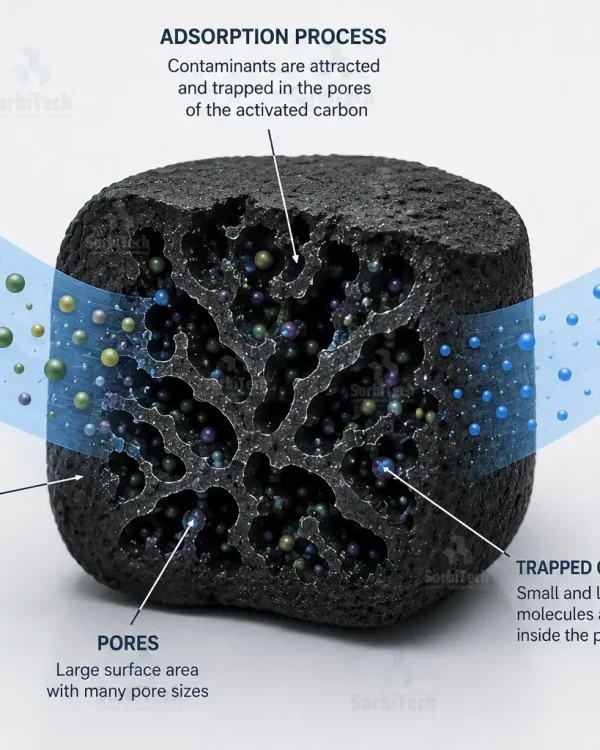
The next decision is chemical. If the target molecule is a stable organic species, straight physical adsorption on a virgin carbon does the work. The molecule is held inside the pore structure by van der Waals interactions, it stays there until saturation, and the bed is either replaced or thermally regenerated at the end of its service life. Most VOC compliance and solvent recovery installations sit in this category.
If the target molecule is reactive, unstable, or present at such low concentration that physical capture would need an uneconomic bed size, the carbon has to carry a chemical reactant. This is where impregnated grades for chemisorption duty enter. A base carbon with a well developed micropore structure is loaded with a small mass fraction of a soluble reagent, dried, and packed into the vessel. When the target molecule reaches an impregnated pore surface, a chemical reaction converts it to an immobile product that stays inside the pore. The reactants most commonly used are potassium hydroxide for acid gases, potassium iodide or sulphur for elemental mercury, and silver for disinfection duty in air handling applications. The choice between these four reagents, and how each loading behaves under different operating envelopes, is where impregnated activated carbon chemistry across KOH, KI, silver and sulphur becomes the load bearing specification decision. The same chemisorption route is what allows odour control at municipal sites to hold back reduced sulphur compounds such as hydrogen sulphide and mercaptans, which are only weakly held by a purely physical bed.
Where to Go for Each of the Five Gas Applications
Five gas applications sit under the wider air and gas purification umbrella. Each has its own plant integration, its own economics, and its own specification detail. Design, sizing, and grade selection specific to each duty are set out where each application is described in detail; the list below points the reader to the right one.
- VOC emission control at petrochemical, coating, and specialty chemical facilities. Deeper compliance framing for activated carbon in VOC emission control against a permit condition covers sizing against continuous and batch peaks.
- Odour control at municipal wastewater, sludge handling, and landfill sites. Field observations from odour control at GCC wastewater and landfill sites cover Dubai, Sharjah, and the northern emirates.
- Solvent recovery at printing, coating, and specialty chemical processes. Twin bed operation and payback analysis for solvent recovery from industrial off gas streams covers steam desorption cycles and condensate handling.
- Biogas polishing at anaerobic digestion and landfill gas facilities.
- Mercury capture at natural gas and produced gas processing trains. Sour gas polishing chemistry at Middle East gas plants using activated carbon for H2S treatment covers Ras Laffan, Shaybah, and Fadhili.
Bed Depth, Empty Bed Contact Time, and Pressure Drop
Once raw material, form, and chemistry are decided, the plant hydraulics decide the rest. Two numbers govern the bed sizing. Empty bed contact time, expressed in seconds, is the volume of the empty vessel divided by the volumetric flow of the gas. Superficial velocity, expressed in metres per second, is the volumetric flow divided by the vessel cross section. For most industrial gas phase work, empty bed contact time sits in the range of one to four seconds and superficial velocity sits between 0.2 and 0.5 metres per second. Values outside this range are workable but come with trade offs on capacity, pressure drop, or channelling risk.
Pressure drop across a packed bed depends on the particle size, the bed depth, and the superficial velocity. A 3 mm pellet bed at 0.4 metres per second and 1 metre depth develops around 250 to 400 pascals of pressure drop per metre, depending on the specific packing. Doubling the velocity roughly quadruples the pressure drop, which is why gas plants that push the throughput beyond the original design see the fan power creep upward long before the carbon itself is spent. Closed loop solvent recovery duty is the exception to typical bed geometry because the desorption cycle drives the vessel design as much as the adsorption stage does, and the bed is sized for the steam side as well as the gas side.
Humidity, Temperature, and the Gulf Operating Envelope
Gas phase carbon in the GCC operates in a different envelope from the same carbon in a European climate. Ambient humidity in the coastal Gulf sits above 60 percent relative humidity for most of the year, and summer humidity in Sharjah, Abu Dhabi, Dammam, and Doha regularly reaches saturation overnight. Water molecules compete with the target contaminant for pore volume, and a saturated air stream can reduce useful capacity for volatile organic compounds by 30 to 50 percent compared with the same carbon operating in a dry stream. This is why cyclic drying, pre cooling, or specification of a carbon with a hydrophobic pore chemistry matters more here than in most other markets. Biogas polishing before combustion is a good example. The digester gas leaves the reactor saturated at 35 to 55 degrees Celsius, and the carbon vessel is nearly always specified with an inlet cooler ahead of the bed to knock out condensate and lower the relative humidity into a range the carbon can work in effectively.
Temperature affects adsorption directly because higher temperatures reduce the equilibrium loading. Most gas phase carbon sits between 15 and 45 degrees Celsius on the working side. Above 50 degrees, the equilibrium loading falls and breakthrough time shortens for the same feed. This is why solvent recovery systems drop the vapour temperature before the adsorption stage even when the desorption stage runs on steam. Regional logistics into activated carbon supply into Saudi industrial hubs such as Jubail, Yanbu, and Ras Tanura also account for storage envelope: pallets held in unshaded yards during a Ras Tanura summer face 50 to 60 degrees Celsius drum temperatures, and the carbon should be under cover from arrival to use to protect the ash and moisture specification the certificate of analysis was written against.
Specification Checklist for Activated Carbon for Air and Gas Purification
Every gas phase enquiry benefits from the same short checklist. Working through it in order avoids the most common causes of a bed underperforming its designed service life.
| Specification item | What to state | Typical range |
|---|---|---|
| Target contaminant and concentration | Molecule name, inlet parts per million or parts per billion, allowable outlet | Application dependent |
| Volumetric gas flow | Actual cubic metres per hour at bed inlet | Application dependent |
| Temperature and relative humidity | Bed inlet, worst case summer envelope | 15 to 45 °C, up to 100 percent relative humidity |
| Empty bed contact time | Seconds, based on empty vessel volume | 1 to 4 s |
| Superficial velocity | Metres per second at bed inlet | 0.2 to 0.5 m/s |
| Physical form | Pellet diameter or granular mesh | 3 mm or 4 mm pellet, 4x8 to 6x12 mesh |
| Iodine number | Micropore adsorption index | above 950 for organic VOC duty |
| Butane working capacity (ASTM D5228) | Gas phase working capacity indicator | above 10 g / 100 g for VOC duty |
| Chemistry (if impregnated) | Reactant, mass fraction, purpose | KOH, KI, sulphur, silver |
| Bed depth and vessel dimensions | Metres, and vessel internal diameter | 0.6 to 3 m depth, application dependent |
The butane working capacity test method (ASTM D5228) is the standard gas phase index used across the industry to compare virgin activated carbons on a like for like basis. It is a laboratory test method that the buyer can specify on the certificate of analysis, giving a directly comparable number across carbons offered against the same gas phase enquiry. For streams containing mercury capture in natural gas trains, the checklist is extended with the impregnation chemistry and the design breakthrough mass loading, since these grades are engineered around a stoichiometric reaction rather than a physical adsorption isotherm.
Field observation. The single most common cause of premature bed breakthrough in Gulf gas plants is not the carbon quality on the certificate of analysis. It is upstream moisture load that was underestimated in the original enquiry, or a fan curve that was reused from a previous project without checking that the new bed pressure drop stays inside the operating envelope. Both are avoided by writing the specification against the worst case summer envelope, not the design day average.
SorbiTech Group Portfolio
Activated Carbon Dubai operates as the regional arm of the SorbiTech™ Group, whose portfolio spans industrial adsorbent and separation systems across gas, water, food, and process treatment programmes. The group also produces specialist adsorption chemistries through Medaad Adsorption Chemicals, whose adsorption chemistry portfolio sits alongside the activated carbon range for plants operating combined purification stages inside a single facility.
Technical enquiries for grade selection, bed sizing, or specification review for activated carbon for air and gas purification can be raised through Contact Us.