Odour control activated carbon wastewater installations sit on the vent headers of almost every municipal treatment plant across the Gulf. Al Aweer sewage treatment plant in Dubai. Bee'ah's material recovery facility in Sharjah. Al Qusais landfill on the northern boundary of the city. All three of these urban infrastructure sites carry a carbon polishing stage on the boundary vent air, catching the residual sulphur and organic odour compounds that would otherwise carry across the fence line into a neighbouring residential or commercial district. The population density of the coastal Gulf and the prevailing wind patterns mean that a wastewater plant boundary that would raise no complaints in a rural European setting can generate weekly odour reports from residents living less than a kilometre downwind. Activated carbon on the vent is the last line of defence against those reports, and getting the specification right is what keeps the site out of the operator's regulatory correspondence. Wider gas phase selection background, before the municipal specifics enter the discussion, sits with activated carbon selection for air and gas purification.
The Odour Compounds a Municipal Plant Actually Produces
Municipal wastewater and landfill sites produce a characteristic mix of odour bodies. The dominant component in wastewater vent air is hydrogen sulphide, generated by sulphate reducing bacteria in the anaerobic sections of the treatment train and in the sludge digestion stage. Concentration in a raw vent header at a treatment plant handling primary sewage typically sits in the range of 5 to 50 parts per million by volume, with occasional excursions above 100 parts per million during upset conditions. Alongside hydrogen sulphide, the vent stream carries lower concentrations of methyl mercaptan, dimethyl sulphide, dimethyl disulphide, and a mix of short chain aldehydes and amines. Individually, each of these compounds has a very low odour threshold; collectively they produce the recognisable sewage plant boundary odour.
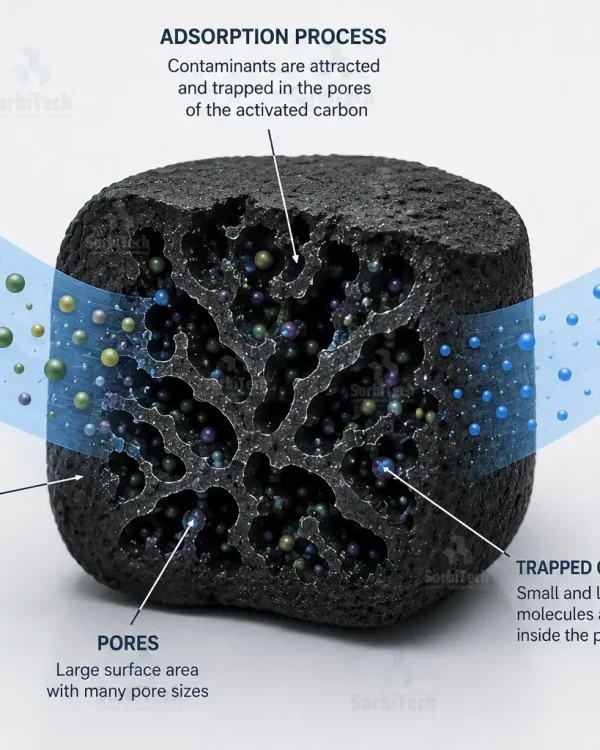
Landfill gas carries a broader mix. Anaerobic decomposition of the buried waste generates methane and carbon dioxide as the bulk gas, with hydrogen sulphide, siloxanes, chlorinated organics, and a wide range of aromatic and aliphatic organic compounds at trace level. Landfill vents produce hydrogen sulphide in a similar concentration range to wastewater vents, but with a more diverse background of organic species. The organic background matters for the carbon selection because it competes with the sulphur compounds for pore volume, and a bed sized against the sulphur load alone can breakthrough faster than expected when the organic co loading is heavy.
Where the Carbon Sits After a Biofilter
Most modern municipal odour control installations use a two stage approach. The primary stage is a biofilter or a bioscrubber that removes the bulk of the odour load through microbial oxidation. Biofilters are cost effective for high sulphur loads and steady state conditions but their outlet performance is variable, especially when the plant swings between operating states or when temperature excursions upset the microbial population. The activated carbon polishing stage sits downstream of the biofilter, catching the residual sulphur and organic compounds that survived the biological stage and holding the outlet consistently below the boundary odour threshold.
The carbon vessel is normally a vertical cylindrical scrubber, typically 1.5 to 3 metres in diameter and 2 to 4 metres tall, with the bed depth in the range of 1 to 2 metres. Empty bed contact time for polishing duty after a biofilter typically sits between 2 and 6 seconds, longer than dry industrial duty because the incoming stream is close to saturation with water vapour. A caustic impregnated activated carbon sitting on a coconut shell base carbon is the standard specification for the hydrogen sulphide load, with a virgin coconut shell grade used where the residual load is dominated by organic species rather than sulphur. The full reagent chemistry behind the caustic loading sits under impregnated activated carbon chemistry across the four industrial reagents, and the same grade appears in industrial sour gas duty at Middle East sour gas plants for H2S polishing.
Media Life Expectancy in Humid Coastal Air
Media life in a Gulf coastal odour control installation is measurably shorter than the same bed operating in a cooler and drier climate. The reason is not the sulphur loading itself, which is comparable, but the water vapour environment. A saturated vent stream at 35 to 40 degrees Celsius carries a much larger mass of water per unit volume than the same stream at 15 degrees. That water competes with the sulphur compounds for pore volume, both by direct competition and by producing a condensed film on the pore wall that reduces access to the impregnation load. Life expectancy for a caustic impregnated bed in a Dubai coastal wastewater plant typically runs 6 to 9 months at design loading; the same bed in a European inland plant typically runs 12 to 18 months.
This has practical implications for the replacement schedule. Plants that operate on a fixed calendar replacement cycle inherited from a European design need to compress that cycle for the Gulf operating envelope. Plants that operate on a performance triggered cycle need an outlet analyser with sufficient sensitivity at 1 part per million by volume, along with a data logging system that records the outlet trend against the boundary odour threshold. Both approaches work; the fixed cycle is simpler operationally and the trigger cycle is closer to optimal on carbon consumption.
A Dubai Wastewater Plant Boundary Case
Al Aweer sewage treatment plant on the southern edge of Dubai handles a substantial fraction of the city's wastewater. The plant boundary sits within a few hundred metres of major road networks and residential development that has expanded outward from the original site perimeter. The primary odour control installation is a series of biofilter cells receiving vent air from the primary settlement tanks, the sludge thickening building, and the digester gas holder. The residual load from the biofilter outlet is polished by a bank of activated carbon scrubbers, each vessel handling a defined fraction of the total plant vent flow.
The observed operational pattern shows peak sulphur loading during summer, when higher water temperatures accelerate anaerobic activity in the influent sewer network. Bed replacement is scheduled for the second quarter of the year, catching the beds fresh ahead of the summer peak. A defined percentage of the total bed volume is replaced at each turnaround, with the remainder rotated between primary and standby duty. The replacement cycle produces a spent carbon stream that leaves the site as a controlled waste, tracked through the emirate's waste manifest system to a licensed disposal facility.
A Landfill Gas Polishing Case
Al Qusais landfill on the northern side of Dubai and the Bee'ah waste management facilities serving Sharjah both operate gas polishing installations that catch the residual odour compounds from the landfill gas collection network. The landfill gas is collected through a network of horizontal and vertical wells across the tipping face and old cell caps, drawn into a central collection header by a set of blowers. The bulk gas either feeds a flare, a gas engine, or an upgrading unit that produces biomethane for the local gas grid, following the same integration pattern used for biogas polishing before combustion. In each case, a slipstream of the collected gas is drawn off and passed through an activated carbon polishing bed before the treated gas returns to the main train, and any fugitive emissions from cell caps and leachate handling are captured by a separate boundary odour system also using activated carbon.
The carbon selection for landfill gas polishing typically uses a caustic impregnated coconut shell grade for the hydrogen sulphide load, sometimes combined with an iron chloride impregnated grade where the sulphur load is unusually high. Siloxane removal for gas engine protection is a separate consideration, usually handled by a dedicated silica gel or aluminosilicate bed upstream of the activated carbon, since siloxanes load onto activated carbon at rates that reduce its usable capacity for the sulphur compounds. Plant integration and grade selection detail for these municipal systems sit alongside odour control across the full range of municipal vent duties, and the liquid side interface where the vent air odour originates sits with municipal wastewater treatment across the primary and secondary train.
Refill Logistics and Downtime Planning
Odour control beds cannot go offline during summer without producing a complaint spike. Refill scheduling therefore has to work around the operating season rather than the calendar. Plants that plan bed changeouts for February and March catch fresh material at the start of the annual load ramp; plants that schedule changeouts in June and July do so at the worst possible point in the load cycle. A twin vessel arrangement with online swap over eliminates the downtime issue entirely and is the layout preferred at newer municipal sites. Older sites that operate a single vessel arrangement typically use a portable rental scrubber during the changeout as an interim capacity, holding the boundary compliance during the operating swap.
Regional supply into activated carbon supply into Bahrain for the compact geography of the kingdom, and equivalent supply routes into the northern emirates from the Dubai warehouse, benefit from short logistics chains that support both scheduled and unscheduled bed changeout. Bulk supply for the standard granular activated carbon for scrubber vessels is held in the warehouse in 25 kilogram bags and 500 kilogram drums, with impregnated grades stocked in sealed drums that protect the impregnation load through the delivery cycle.
Case observation. The most reliable single predictor of a municipal odour control system generating repeat resident complaints is not the peak outlet concentration; it is the frequency of short outlet spikes above the odour threshold, typically caused by biofilter cell disturbance or transient inlet load. A well-sized activated carbon polishing bed absorbs these spikes and holds the boundary compliance through the transient event, provided the bed is not close to the end of its service life. Complaint frequency correlates more closely with time since last bed replacement than with average outlet concentration.
SorbiTech Group Portfolio
Activated Carbon Dubai supplies odour control grade activated carbon into municipal treatment sites and landfill gas installations across the wider Gulf under the SorbiTech™ Group portfolio. Regional stock of both virgin and caustic impregnated grades is held in the Dubai and Sohar warehouses, giving lead times short enough to support both scheduled turnaround loadings and interim rental deployments during unplanned changeouts. The wider industrial adsorbent portfolio covers adjacent water and gas treatment applications, complemented by Medaad Adsorption Chemicals for specialty adsorption chemistries.
Technical enquiries for odour control activated carbon wastewater grade selection, bed sizing, or replacement scheduling can be raised through Contact Us.