Wastewater treatment plants are designed to remove the bulk pollutant load from sewage and industrial effluent before the water is discharged or reused. Conventional biological and physical treatment handles most of the contaminant load, but a wide range of dissolved organic compounds passes through these stages and reaches the discharge point. Activated carbon is the established tertiary treatment technology used to remove these residual contaminants, particularly the trace organics that affect water quality, regulatory compliance, and downstream reuse. As an activated carbon manufacturer and supplier, SorbiTech provides carbon media engineered for the specific demands of industrial and municipal wastewater service.
How Activated Carbon Cleans Wastewater
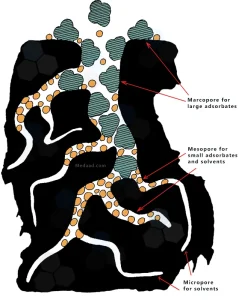
Think of activated carbon as a sponge with an enormous number of tiny pores inside. When wastewater flows through a carbon bed or contacts powdered carbon in a tank, dissolved pollutants move from the water into those pores and stick to the surface.
The rate and capacity of adsorption depend on three variables: the physical and chemical properties of the target contaminant, the pore structure of the activated carbon, and the hydraulic and contact time conditions of the treatment system. Low molecular weight organics adsorb preferentially in micropores below 2 nm. Higher molecular weight compounds such as humic substances, colour bodies, and large pharmaceutical molecules require mesopores (2 to 50 nm) for access. The carbon grade must therefore be matched to the dominant contaminant class in the effluent.
Activated carbon does not transform contaminants chemically. It removes them from the water phase and concentrates them on the carbon surface, which is why spent carbon can be thermally reactivated at 900 °C in a rotary furnace, restoring 90 to 95 percent of its original adsorption capacity and allowing multiple service cycles before the carbon is finally retired.
Industrial Wastewater Streams
Industrial wastewater varies significantly between sectors, and the activated carbon selected reflects the dominant contaminant chemistry. Refinery and petrochemical effluent typically requires the removal of dissolved hydrocarbons and phenols. Textile and dye plant wastewater requires colour body removal at high concentration. Pharmaceutical and chemical manufacturing wastewater carries trace API residues and synthesis intermediates. Each of these streams benefits from carbon grades selected for the right pore size distribution and the right hardness for the operating cycle.
Granular activated carbon GAC is the standard choice for continuous fixed bed treatment, while powdered carbon is used where contaminant peaks need to be handled in batch mode or where existing biological tanks can serve as the contact vessel.
Water reuse and zero liquid discharge programmes also rely on activated carbon to deliver the consistent water quality required for boiler feed, cooling tower makeup, or general industrial reuse. The same carbon technology used here is closely related to the polishing role activated carbon plays in industrial process water applications.
Selection Criteria for Wastewater Carbon
Activated carbon for wastewater service is selected based on the specific contaminant profile and the operating environment of the bed. Key parameters include the iodine number and methylene blue value, which together indicate the carbon’s capacity for small and large molecules. Particle hardness is critical because wastewater carbon is typically reactivated several times over its life. Backwash and abrasion durability determine how well the carbon survives the cyclic loading inherent in continuous service.
Choosing the correct raw material is also important. Coal based grades are commonly selected for wastewater because of their balanced pore structure and excellent reactivation behaviour, while coconut shell grades are favoured where catalytic activity for specific contaminants is required.
SorbiTech Activated Carbon for Wastewater Treatment
SorbiTech supplies granular activated carbon and powder activated carbon for industrial and municipal wastewater treatment systems, including refinery effluent, petrochemical plants, pharmaceutical manufacturing wastewater, and tertiary treatment of municipal sewage. Carbon grades are selected based on the contaminant profile and the plant’s operating cycle, with full analytical documentation supplied for every batch.
SorbiTech also supports operators with bench scale testing using real effluent samples, allowing accurate forecasting of carbon usage rate and bed life before commitment. To discuss your wastewater treatment requirements and the right carbon grade for your plant, contact the SorbiTech technical team.