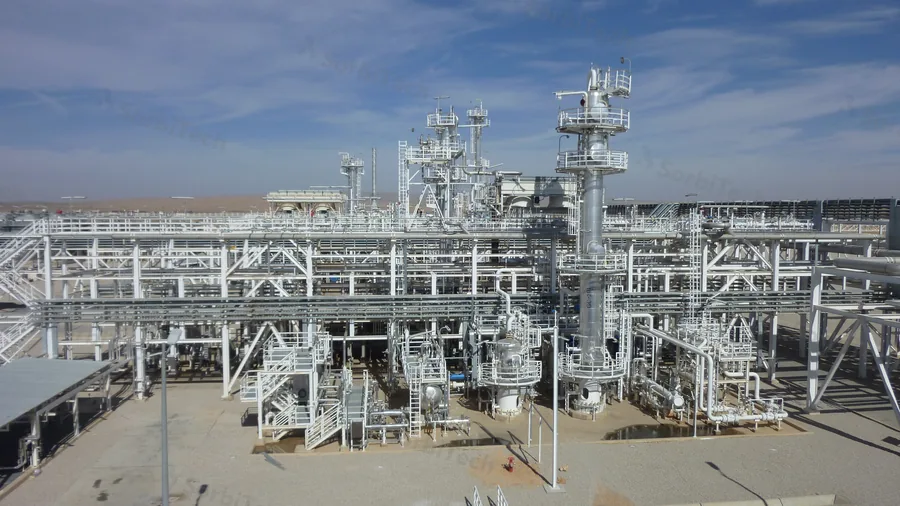
Sour gas h2s treatment activated carbon beds sit at the tail end of almost every gas processing train across the Middle East. The Khuff formation, which underlies large parts of Saudi Arabia, Qatar, and the Emirates, delivers a natural gas stream that arrives at the surface with hydrogen sulphide levels ranging from a few thousand parts per million into the low percentage range by volume. That level of hydrogen sulphide has to come out of the gas before the stream is sent to a pipeline, a liquefaction train, or a downstream petrochemical facility. Amine treating units take the bulk of the load. Sulphur recovery units convert the concentrated acid gas into elemental sulphur. And a carbon polishing bed sits between the amine tail gas and the vent, catching the residual hydrogen sulphide that the earlier stages do not fully hold back. The sections below cover how that carbon bed operates in three Gulf gas plants, and where the specification is genuinely different from a general gas phase enquiry. Wider selection background for gas phase carbon, before the sour service specifics enter the discussion, sits with activated carbon selection for air and gas purification.
The Sour Gas Landscape in the Gulf Region
The Khuff reservoir is a Permian carbonate that stretches from central Saudi Arabia across the Arabian Gulf into Qatar and into the Emirates. Gas from Khuff wells is characteristically sour: hydrogen sulphide content ranges from around 1 percent by volume at the low end into the range of 5 to 10 percent by volume in the deeper and older sections of the reservoir. Carbon dioxide levels also sit in the low percentage range, and mercury and heavier hydrocarbons are commonly present at trace level; the mercury fraction is handled by a separate mercury capture stage in the gas train using either sulphur or potassium iodide impregnated carbon depending on the moisture profile. Every gas plant treating a Khuff feed handles a stream that would corrode a carbon steel pipeline within days if the acid gas load was left in.
The three plants used as reference points in this case study are Ras Laffan in Qatar, which processes gas from the North Field extension of Khuff and feeds the largest liquefied natural gas complex in the world; Shaybah in the Empty Quarter of Saudi Arabia, which produces both crude and associated sour gas from Ghawar adjacent reservoirs and sends the gas to a nearby processing hub; and Fadhili, a large sour gas processing facility in the eastern province of Saudi Arabia which was commissioned specifically to handle Khuff and Hasbah feeds. All three plants use amine treating as the primary acid gas removal stage. All three place a carbon polishing bed downstream of the amine unit as a final trim before the treated gas leaves the fence line.
Where Activated Carbon Fits in the H2S Removal Chain
The amine unit is the primary acid gas removal stage. A regenerable liquid amine solvent, typically methyl diethanolamine or a proprietary blend, absorbs hydrogen sulphide and carbon dioxide from the sour gas at moderate pressure and low temperature. The rich amine is then heated in a regenerator column, releasing a concentrated acid gas stream that goes to the sulphur recovery unit. The lean amine returns to the absorber. The treated gas that leaves the top of the amine absorber typically carries residual hydrogen sulphide in the range of 4 to 20 parts per million by volume, depending on the tightness of the amine specification.
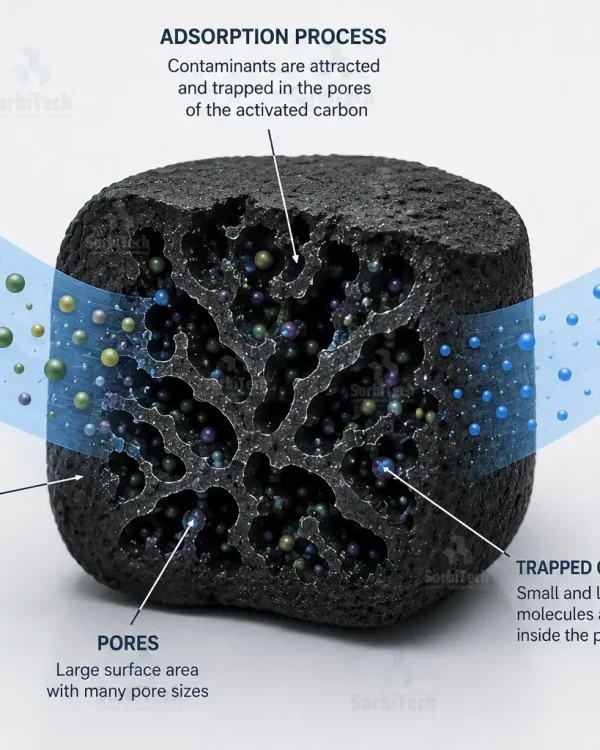
Pipeline specifications for sales gas usually require hydrogen sulphide below 4 parts per million by volume, and liquefaction feed specifications for cryogenic trains are commonly written to below 1 part per million. That last 3 to 19 parts per million of hydrogen sulphide is what the activated carbon polishing bed is asked to remove. The carbon bed sits after a knockout drum that removes any entrained amine solution, and before the compression or metering stage that sends the treated gas to its destination. A caustic impregnated carbon holds the residual hydrogen sulphide by chemical reaction, converting it to a stable sulphide compound inside the pore that stays in place until the bed reaches design mass loading and is replaced. The underlying reagent chemistry, and how the potassium hydroxide loading is set for a given operating envelope, is described alongside the wider impregnated carbon chemistry across KOH, KI, silver and sulphur.
Amine Tail Gas Polishing with Activated Carbon
The amine tail gas leaves the top of the amine absorber close to the operating pressure of the absorber itself, which for a sour gas plant typically means 60 to 80 bar gauge. Temperature is close to the lean amine inlet temperature, around 40 to 50 degrees Celsius. The stream is saturated with water vapour at that temperature and pressure. Before the carbon bed, an inlet cooler and a coalescer knock out condensate and any entrained amine droplets. A dry, particulate free gas is what actually reaches the carbon.
The carbon vessel itself is a vertical fixed bed cylinder, typically 2 to 4 metres in diameter and 3 to 6 metres tall, sized for an empty bed contact time in the range of 8 to 15 seconds at design flow. That is significantly longer than the 1 to 4 seconds used for typical volatile organic compound duty, because the driving force at low residual concentration is small and the chemisorption reaction needs time to complete. A chemisorption grade activated carbon loaded with potassium hydroxide at a mass fraction of around 10 percent, sitting on a coconut shell base substrate for its mechanical strength through wetting and drying cycles, is the standard choice. The reaction converts hydrogen sulphide to potassium sulphide inside the pore, holding the sulphur in place until design mass loading is reached.
Bed Design for Wet H2S Service
Wet hydrogen sulphide service places a set of constraints on the vessel and the carbon that dry gas phase duty does not. The vessel wall material has to handle the combined risk of aqueous sulphide corrosion and hydrogen induced cracking. Fabrication codes typically call for low carbon steel with heat treatment after welding and internal cladding or an internal coating rated for sour service. The bed support has to allow drainage of any liquid water that condenses during a shutdown or a temperature swing, because pooled water at the bed base will produce localised corrosion and can cause the carbon to disaggregate.
The carbon itself has to keep its integrity through wetting and drying cycles. A caustic impregnated carbon with a soft base substrate will slump under repeated wetting; a hard, dense coconut shell base carbon holds its shape and its impregnation load across many months of wet service. Design mass loading for a caustic impregnated bed on amine tail gas polishing typically sits in the range of 12 to 20 percent by mass of sulphur held per mass of carbon, but the achievable loading is lower in a stream that swings frequently between full and turndown flow, because partial loading of the bed accelerates local breakthrough. This is why plants that run stable base load flow generally reach the top of the loading range and plants that follow variable pipeline demand generally reach the lower end.
| Service parameter | Amine tail gas polishing | General gas phase VOC duty (for reference) |
|---|---|---|
| Inlet H2S concentration | 4 to 20 ppmv | not applicable |
| Outlet H2S specification | below 1 to 4 ppmv | not applicable |
| Empty bed contact time | 8 to 15 seconds | 1 to 4 seconds |
| Operating pressure | 60 to 80 bar gauge | close to atmospheric |
| Water saturation | fully saturated at bed inlet | below 60 percent relative humidity preferred |
| Carbon grade | KOH impregnated, coconut shell base | virgin coconut or coal, extruded pellet |
| Design sulphur loading | 12 to 20 percent by mass | not applicable |
| Vessel metallurgy | sour service, heat treated after welding | carbon steel, standard fabrication |
| Bed replacement trigger | outlet H2S rise above alarm setpoint | outlet contaminant rise or pressure drop rise |
Sour Gas H2S Treatment Activated Carbon: Field Observations from Gulf Gas Plants
Three field observations recur across the plants using activated carbon for hydrogen sulphide polishing in the Gulf. The first is that outlet analyser drift is a bigger operational problem than most operators expect. Ultra low hydrogen sulphide concentration is difficult to measure reliably at 1 part per million by volume, and the readings that trigger a bed changeout are frequently affected by analyser calibration rather than actual bed exhaustion. Plants at Ras Laffan and Fadhili run duplicate analysers on the outlet header, with weekly cross calibration against a lead acetate paper reference, specifically to distinguish real breakthrough from instrument drift. Plants that rely on a single analyser tend to change beds early, wasting carbon capacity that is still active.
The second observation is that the reduction in loading during turndown periods is real and worth designing around. A bed sized against the peak flow will operate at low superficial velocity during turndown, and the reduced turbulence at low velocity leaves parts of the bed under utilised. Plants that follow a broad flow envelope, particularly plants that step up and down for weekly maintenance cycles at downstream units, get better carbon utilisation from a slightly smaller vessel sized against the median flow rather than the peak, accepting that a peak flow event might produce a short breakthrough episode caught by the outlet analyser and handled by a bypass to a standby vessel.
The third observation is regional. Plants at Shaybah, deep in the Empty Quarter, face storage temperatures for spare carbon drums that regularly exceed 55 degrees Celsius during the summer months. Caustic impregnated carbon held at temperatures above 50 degrees for extended periods gradually loses reactive potassium hydroxide through migration and carbonate formation with atmospheric carbon dioxide. Storage under shade with regular rotation of stock, or in a temperature controlled warehouse, protects the impregnation load through to the point of vessel loading. Regional service centres serving Saudi gas plants, including activated carbon delivery into Saudi industrial hubs at Dammam and Jubail, are the preferred logistics route because they compress the exposure of the drums to extreme ambient conditions between manufacture and installation. Similar logistics apply to activated carbon supply into Qatar gas processing for the Ras Laffan complex, where the receiving warehouses at Mesaieed are climate controlled specifically for temperature-sensitive impregnated media.
Field observation. A hydrogen sulphide breakthrough event on the polishing bed almost never announces itself gradually. The outlet concentration typically rises from below 1 part per million to above the alarm threshold in a matter of hours once the bed reaches its saturation front. Plants that have a hot standby vessel with preloaded fresh carbon and valves already piped for online swap over avoid the plant shutdown that would otherwise follow a breakthrough. Plants without a hot standby take a full plant trip.
The plant boundary odour management practice at these facilities also draws on the same chemisorption chemistry, though for a different reason. Amine unit vents, sulphur recovery incinerator tails, and pit and drain vent stacks all carry residual sulphur compounds that would produce a boundary odour signal if left uncontrolled. Small carbon polishing beds on those vents share the caustic impregnated grade selection with the main gas train, though at very different bed geometry and replacement cycle. Municipal boundary applications of the same chemistry appear at wastewater and landfill vent installations across the GCC, where a similar hydrogen sulphide load is handled at lower pressure but much higher inlet moisture. Spent beds from gas plant service that arrive at their end of life mass loading are usually a candidate for licensed disposal rather than thermal reactivation of spent carbon, since the sulphide loading changes the reactivation kiln economics compared with a virgin organics loading.
SorbiTech Group Portfolio
Activated Carbon Dubai supplies caustic impregnated activated carbon for sour gas polishing service into gas plants across Saudi Arabia, Qatar, the Emirates, and Oman under the wider SorbiTech™ Group gas treatment portfolio. Regional service centres in Dubai and Sohar hold stock of the standard sour service grade, giving delivery lead times short enough to support both scheduled turnaround loadings and unplanned hot standby replenishment. The group also produces specialist adsorption chemistries through Medaad Adsorption Chemicals, which fits alongside the activated carbon range for plants operating combined treatment stages inside a single facility.
Technical enquiries for sour gas h2s treatment activated carbon grade selection, bed sizing, and replacement scheduling can be raised through Contact Us.