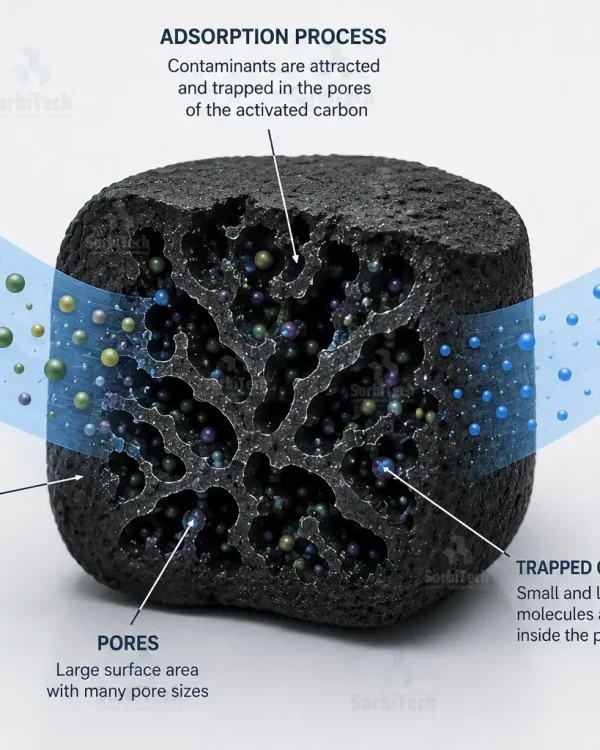
Impregnated activated carbon chemistry is what separates the routine physical adsorbent from a material engineered to capture a specific molecule at parts per billion concentration. A virgin impregnated activated carbon product holds its target through a chemical reaction at the pore surface, rather than through van der Waals forces alone. The molecule reaches the pore, reacts with the loaded reagent, and stays as a stable product until the reagent load is exhausted. That single change transforms the working capacity, the useful temperature range, and the target molecule selectivity of the carbon. The four impregnation chemistries most commonly used in industrial practice are potassium hydroxide for acid gases, potassium iodide and sulphur for mercury, and silver for disinfection duty. Each is described in the sections that follow. Selection at the wider gas phase level, before the chemistry decision is made, is where activated carbon selection for air and gas purification sits in the specification flow.
The Base Carbon Surface Before Impregnation
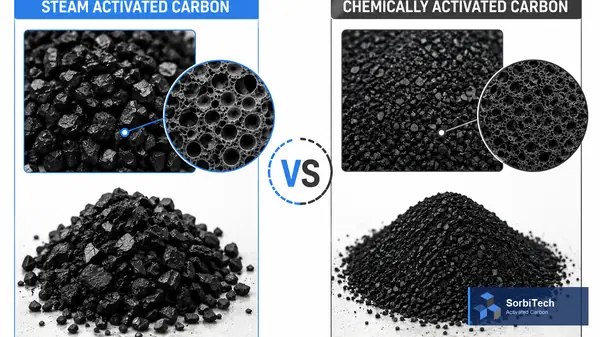
Every impregnated carbon starts life as a base carbon with its own established pore structure and surface chemistry. The base is nearly always a hard, dense, low ash coconut shell steam activated grade, because the impregnation process places significant demands on the mechanical strength and the purity of the substrate. A soft base carbon disaggregates during the impregnation solution loading and the subsequent drying stage. A high ash base carbon carries mineral impurities that interfere with the reagent loading and produce inconsistent batch to batch performance. The pore structure the base carbon provides has to be predominantly microporous, since the reagent has to load into the same pore space that will later hold the reactant molecule. For very high acid gas loads or unusually broad organic co loading, a coal based activated carbon substrate is sometimes used instead, giving a broader pore distribution at the cost of some mechanical strength.
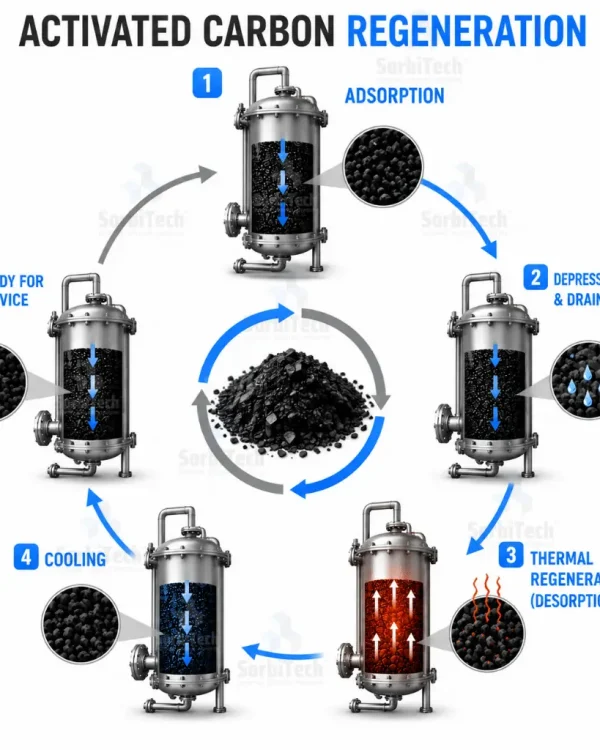
The impregnation itself is a solution loading step. The base carbon is immersed in an aqueous solution of the target reagent at controlled temperature and controlled contact time, the solution enters the pore space by capillary action, and the excess is drained. The impregnated carbon is then dried at temperature high enough to remove the water without decomposing the reagent, and cooled to ambient before packaging. Typical reagent loading ranges from 5 to 15 percent by mass of the finished carbon, though specialty grades can go higher.
Potassium Hydroxide for Acid Gases
Potassium hydroxide impregnation is the standard chemistry for acid gas removal from gas streams. The alkali reagent, loaded at roughly 5 to 10 percent by mass, reacts with acid gas molecules (hydrogen sulphide, sulphur dioxide, hydrogen chloride, hydrogen fluoride) on contact with the pore surface. Hydrogen sulphide reacts to form potassium sulphide and water. Sulphur dioxide reacts to form potassium sulphite. Hydrogen chloride reacts to form potassium chloride. In each case, the product is a soluble salt that stays inside the pore until the reagent loading is exhausted.
The working capacity of a KOH impregnated carbon is governed by the reagent loading, not by the physical adsorption capacity of the base carbon. A carbon carrying 10 percent by mass KOH has enough reagent to remove roughly 5 percent by mass of hydrogen sulphide before the alkali is consumed, based on the 2:1 stoichiometric ratio. In practice the achievable loading is lower because a fraction of the reagent is inaccessible to the incoming gas due to pore diffusion limitations. Wet gas conditions and higher operating temperatures both improve reagent access; dry gas at low temperature leaves more reagent unused when breakthrough occurs. Field deployment of caustic impregnated grades handles the last few parts per million of hydrogen sulphide on amine tail gas polishing at Middle East sour gas plants, and the same chemistry supports biogas polishing before combustion where H2S removal is the primary requirement before the gas reaches the engine or upgrading unit.
Potassium Iodide for Elemental Mercury
Elemental mercury in natural gas streams is difficult to capture by physical adsorption alone because its vapour pressure at ambient temperature is low but its concentration is often lower still. A physical bed sized against the equilibrium isotherm for elemental mercury would need to be uneconomically large. Potassium iodide impregnation solves the problem by adding a reagent that reacts with mercury vapour on contact, forming mercuric iodide, a solid compound that stays inside the pore.
A typical KI impregnated carbon carries 5 to 7 percent by mass of the reagent. The reaction is stoichiometric: each mole of KI reacts with one atom of mercury, though in practice the mercury capture ratio is limited by the accessibility of the impregnated pore surface. Design mercury loading for a KI impregnated bed on a dry natural gas stream typically sits in the range of 3 to 6 percent by mass of mercury per mass of carbon. The bed geometry allows the mercury to reach the impregnated surface within the empty bed contact time, and the outlet mercury concentration remains below the design threshold until the reagent is spent.
Sulphur for Mercury in Wet Natural Gas
Sulphur impregnated carbon competes with KI impregnated carbon for mercury removal duty, but the two chemistries have different operating envelopes. Sulphur impregnated grades carry elemental sulphur, typically at 8 to 15 percent by mass, dispersed inside the pore space of the base carbon. Elemental mercury reacts with sulphur to form mercuric sulphide, a highly stable solid with extremely low solubility that stays permanently inside the pore. The reaction is fast at ambient and moderately elevated temperatures, and the sulphur grade tolerates wet gas conditions substantially better than the KI impregnated grade.
Wet natural gas trains at Gulf gas processing hubs, particularly the sour gas processing facilities at Ras Laffan and the Saudi eastern province gas plants, therefore favour the sulphur impregnated grade. The KI grade is preferred for dry natural gas trains and for regeneration friendly service, since the potassium iodide reagent can be more easily washed out during a periodic wash cycle if the bed is being prepared for reuse rather than disposal. The sulphur grade cannot be washed out and is a single use consumable.
Silver for Disinfection Duty
Silver impregnated activated carbon carries metallic silver, typically at 0.05 to 0.5 percent by mass, deposited inside the pore structure of the base carbon. The silver acts as a biocide against bacteria and biofilm growth inside the bed, which is a significant problem in warm, moist air handling systems. Applications include drinking water pretreatment where microbiological growth on the carbon would otherwise degrade the treated water quality, and air handling systems in hospitals and cleanrooms where the carbon bed itself needs to be biologically inert.
Silver impregnated carbon also has a secondary role in the removal of ethylene from air streams around fruit storage warehouses. Ethylene is a plant hormone that accelerates fruit ripening, and controlling its concentration in a controlled atmosphere storage extends the shelf life of exported produce. Silver impregnated carbon holds ethylene through a combination of physical adsorption and chemisorption at the silver surface, extending working capacity substantially compared with a virgin base carbon.
| Impregnation | Typical loading | Primary target | Product formed | Preferred conditions |
|---|---|---|---|---|
| Potassium hydroxide (KOH) | 5 to 10 % by mass | H2S, SO2, HCl, HF | Potassium salts | Wet gas, moderate temperature |
| Potassium iodide (KI) | 5 to 7 % by mass | Elemental mercury | Mercuric iodide | Dry natural gas, ambient temperature |
| Elemental sulphur (S) | 8 to 15 % by mass | Elemental mercury | Mercuric sulphide | Wet gas, moderate temperature |
| Silver (Ag) | 0.05 to 0.5 % by mass | Bacteria, ethylene | Silver bound species | Air handling, warm and moist |
Choosing the Right Impregnant for Your Gas Stream
The choice of impregnation is set by the target molecule and the operating envelope. Acid gases (H2S, SO2, HCl) mean KOH. Elemental mercury on a dry train means KI. Elemental mercury on a wet train means sulphur. Disinfection duty or ethylene control means silver. Where multiple targets are present, layered beds are common: a KOH impregnated layer above a sulphur impregnated layer will remove both acid gas and mercury from a single vessel, though at the cost of more complex operations and shorter individual layer life. Commercial grades in each of the four chemistries sit under the SorbiTech impregnated activated carbon range, built on the granular base carbon substrate that carries each reagent.
Regional application context in the Gulf includes mercury capture systems in gas trains at both dry and wet natural gas facilities, and general acid gas polishing across the sour gas processing landscape. Regional supply into activated carbon supply into Qatar gas processing at Ras Laffan uses the sulphur impregnated grade extensively; equivalent supply into activated carbon delivery into Saudi gas hubs and Kuwaiti gas plants uses a mix of KOH and sulphur grades depending on the specific unit duty. The same caustic impregnated chemistry appears on the vent side of many municipal treatment sites, where activated carbon on GCC wastewater and landfill vent headers holds boundary odour compliance against a similar hydrogen sulphide load at much lower pressure and higher moisture than a gas plant duty.
Stability of Impregnated Carbons in Humid Gulf Conditions
Impregnated carbons are sensitive to their storage environment. Prolonged exposure to elevated temperature and humidity between manufacture and installation degrades the impregnation load. Potassium hydroxide grades slowly absorb atmospheric carbon dioxide, converting the active KOH to less active potassium carbonate. Potassium iodide grades gradually darken under exposure to light and moisture, indicating slow oxidation of the iodide. Sulphur grades are the most stable of the four, though they can develop a surface deposit of elemental sulphur if exposed to condensing conditions during storage.
Storage guidance for impregnated grades is straightforward: keep the drums sealed until installation, hold them in a shaded and preferably ventilated warehouse, and rotate stock so no drum sits in storage for more than a few months. Regional service centres serving Gulf gas processing installations, including the Dubai and Sohar warehouses that supply into UAE and Omani gas plants, hold impregnated stock under climate controlled conditions specifically to protect the reagent loading through to the point of installation.
Chemistry note. An impregnated bed that has been in storage or under unusual operating conditions cannot be assumed to have its full nominal reagent loading. The certificate of analysis is the reference for the freshly manufactured lot; the actual reagent content of a bed loaded from that lot depends on the intervening storage and handling. Plants that suspect reagent loss in a bed can send a sample to the manufacturer for reagent content assay before commissioning the vessel.
SorbiTech Group Portfolio
Activated Carbon Dubai supplies impregnated activated carbon grades in all four chemistries described above under the SorbiTech™ Group portfolio. Standard KOH and sulphur grades are held in climate controlled storage at the Dubai and Sohar service centres, supporting both scheduled loading and unscheduled hot standby replenishment. Specialty KI and silver grades are supplied on a project basis with lead time set by the required reagent loading and the base carbon specification. The wider industrial adsorbent portfolio covers virgin gas phase and liquid phase duties alongside specialty adsorption chemistries from Medaad Adsorption Chemicals.
Technical enquiries for impregnated activated carbon chemistry selection, reagent loading verification, or bed sizing against a specific target molecule can be raised through Contact Us.