What Is Activated Carbon?
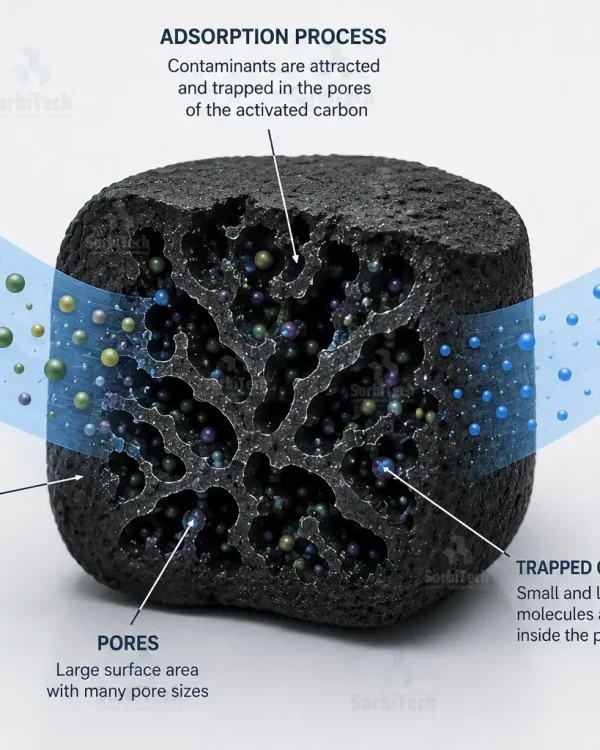
Activated carbon is a highly porous form of carbon that has been processed to create millions of tiny pores on its surface. These pores dramatically increase the surface area available for adsorption, the process by which contaminants are captured and held on the carbon surface. A single gram of quality activated carbon can have a surface area of over 1,000 square meters, roughly the size of several tennis courts.
Common Raw Materials
The choice of raw material directly influences the pore structure, adsorption capacity, and performance of the final product:
| Raw Material | Key Characteristics | Typical Applications |
|---|---|---|
| Coconut Shell | Microporous, high hardness, high density | Drinking water, gold recovery |
| Bituminous Coal | Balanced pore structure (micro + meso) | Wastewater, process water |
| Lignite Coal | Larger pore sizes, high mesoporosity | Sugar decolorization |
| Wood | High mesoporosity, softer structure | Pharmaceutical, edible oil |
At SorbiTech™, we manufacture and supply activated carbon from carefully selected raw materials to meet specific application requirements.
How Is Activated Carbon Made?
The production of activated carbon involves two main stages: carbonization and activation. Each stage plays a critical role in creating the final product’s unique structure and adsorption properties.
Stage 1: Carbonization
During carbonization, the raw material is heated in a controlled environment at temperatures between 400°C and 600°C in the absence of oxygen. This thermal decomposition removes volatile compounds such as water, methane, and tar. What remains is a carbon rich char with a basic pore structure, but this char still has limited adsorption capacity.
Stage 2: Activation
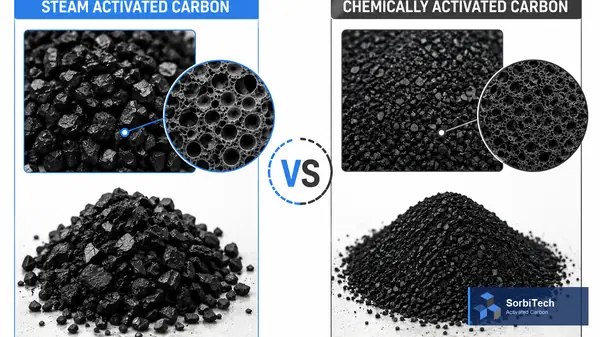
The activation stage transforms ordinary char into highly porous activated carbon. There are two primary methods:
Steam Activation (Physical Activation)
- Carbonized material is exposed to steam at 800°C to 1,100°C
- Steam reacts with carbon to create and enlarge the internal pore network
- Produces carbon with well developed micropore structure
- Ideal for drinking water treatment and gold recovery
Chemical Activation
- Raw material treated with activating agents (phosphoric acid, zinc chloride) before heating at 400°C to 700°C
- Produces carbon with higher mesoporosity
- Well suited for sugar decolorization and pharmaceutical purification
The Adsorption Process: How Activated Carbon Captures Contaminants
Activated carbon works through a process called adsorption. Unlike absorption, where a substance is taken into the bulk of a material (like a sponge soaking up water), adsorption captures contaminants on the carbon surface through molecular attraction. This surface level interaction is what makes activated carbon so effective at targeting specific pollutants without altering the treated medium itself.
Two Adsorption Mechanisms
| Mechanism | How It Works | Best For |
|---|---|---|
| Physical Adsorption (Van der Waals) | Weak intermolecular forces attract contaminant molecules to the carbon surface | Most organic compound removal |
| Chemical Adsorption (Chemisorption) | Stronger chemical bonds form between contaminant and carbon surface | Hydrogen sulfide, mercury removal |
Factors That Influence Adsorption Performance
- Pore size distribution of the carbon relative to contaminant molecule size
- Contaminant concentration in the water or gas being treated
- Contact time between the carbon and the medium
- Temperature and pH of the operating environment
- Competition between multiple contaminants for available adsorption sites
Understanding these factors is essential when selecting the right carbon type for a given process (see our guide on choosing activated carbon for water treatment). The lifespan of activated carbon in service depends heavily on contaminant loading and system design. In water treatment, GAC filters typically operate for 6 to 24 months before the carbon needs replacement or reactivation, while PAC is used on a single dose basis and removed after treatment.
Types of Activated Carbon
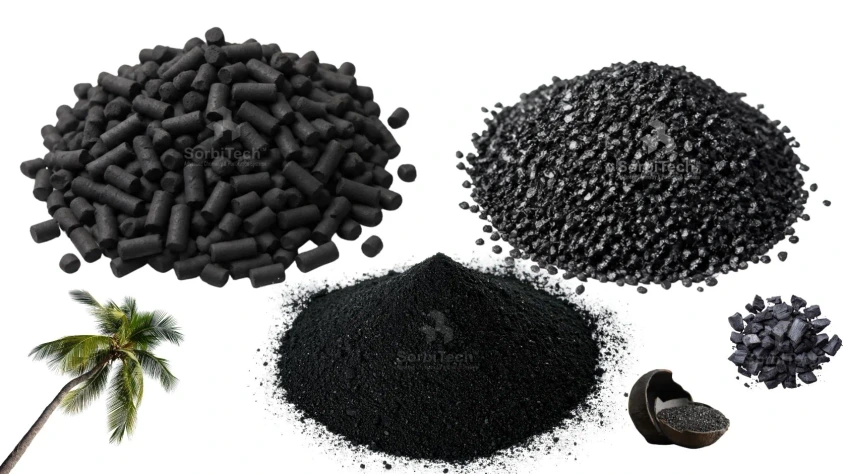
Activated carbon is available in several physical forms, each designed for specific applications and system requirements:
Powder Activated Carbon (PAC)
Fine particles typically smaller than 0.15mm, used in batch treatment processes. PAC is added directly to the water or liquid being treated, providing rapid adsorption kinetics. Commonly used for taste and odor control in drinking water and decolorization in edible oil refining.
Granular Activated Carbon (GAC)
Particle size typically ranging from 0.5mm to 4mm, used in fixed bed filters and adsorbers. GAC allows for continuous treatment and can be thermally reactivated for reuse, making it a cost effective long term solution. Widely used in wastewater treatment, industrial process water, and VOC removal systems.
Pelletized Activated Carbon
Formed into uniform cylindrical pellets (1mm to 5mm diameter), providing excellent flow characteristics and low pressure drop. Pelletized carbon is the preferred choice for gas phase applications including biogas purification, odor control, and solvent recovery.
Specialty Grades
- OraPure Activated Carbon from SorbiTech™ is specifically engineered for gold recovery operations, offering superior hardness and adsorption capacity for CIP and CIL circuits.
- Impregnated Activated Carbon is treated with specific chemicals to enhance removal of target compounds such as hydrogen sulfide, mercury, and other hazardous gases.
Activated carbon approved for drinking water applications must meet strict safety certifications or equivalent international standards. SorbiTech™ provides documentation and compliance support for all regulated applications.
Industrial Applications Overview
| Sector | Application | Recommended Carbon Type |
|---|---|---|
| Water Treatment | Drinking water, wastewater, desalination | GAC, PAC |
| Air & Gas | VOC removal, odor control, mercury capture | Pellets, Impregnated |
| Food & Beverage | Sugar refining, edible oil, beverage clarification | PAC, GAC |
| Mining | Gold recovery (CIP/CIL) | OraPure, GAC |
| Pharmaceuticals | API purification | PAC |
Why Choose SorbiTech™ as Your Activated Carbon Supplier?
As a leading Activated Carbon Manufacturer and Supplier, SorbiTech™ Group provides engineered carbon solutions tailored to your specific process requirements. Our product range covers all major types, from PAC and GAC to pelletized and impregnated grades.
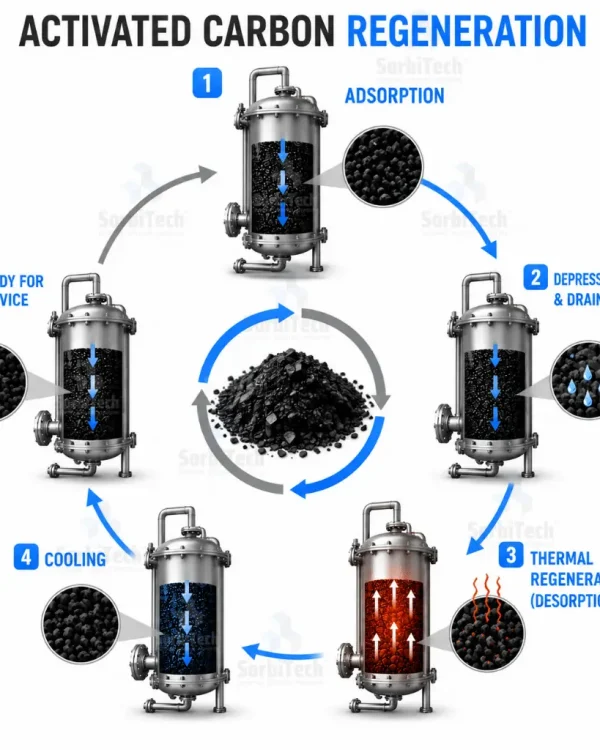
Every batch undergoes rigorous quality control testing for iodine number, surface area, moisture content, ash content, and hardness. GAC and pelletized forms can also be thermally reactivated at 700°C to 900°C, restoring a significant portion of original capacity and reducing long term operating costs.
Contact SorbiTech™ today for technical consultation, product samples, or a tailored quote for your requirements.