Activated carbon for VOC emission compliance sits at the heart of the abatement train at almost every industrial facility across the GCC that operates under a written air permit. A resin plant in Ruwais uses it to hold styrene and toluene vapour off the storage tank vent header. A powder coating line in the Dubai Investment Park uses it to catch xylene and methyl ethyl ketone from the paint booth exhaust. A specialty chemical facility in Yanbu uses it to keep the process vent below the permitted total volatile organic carbon concentration during a batch reactor purge. Each of these plants writes its emission report against a specific permit condition, and the carbon adsorption stage is what turns raw permit conformance into a defensible number on the monthly submission. The sections below cover the compliance decision from the perspective of the plant engineer preparing a specification against a permit condition. Broader gas phase selection background, before the compliance framing is added, sits with activated carbon selection for air and gas purification.
What VOC Actually Covers in a Plant Permit
Volatile organic compounds are defined in most GCC and international regulatory instruments as organic species that evaporate under normal ambient temperature and pressure conditions. In practice, the definition arrives in a plant permit as a list. The list may include specific named substances (benzene, toluene, xylene, methanol, formaldehyde, and so on) with individual concentration limits, or it may include a total volatile organic carbon number expressed as an equivalent methane or hexane concentration, or both. Some permits also include exempt compound lists, typically covering species judged not to contribute to ground level ozone formation. Reading the permit definition carefully is the first task, because a carbon system sized against the wrong reference number will meet the design specification without meeting the actual permit.
The permit almost always specifies a monitoring point, an averaging period, and a reporting frequency. Monitoring points are typically stack outlets or fenceline monitors. Averaging periods range from hourly to daily to monthly. Reporting frequencies range from continuous to quarterly. The combination of these three parameters defines the operating window the carbon system has to hold. A one hour average limit is very different from a monthly average limit, and the bed sizing and replacement schedule respond to that difference.
Activated Carbon for VOC Emission Compliance: Adsorption Capacity for Typical Mixtures
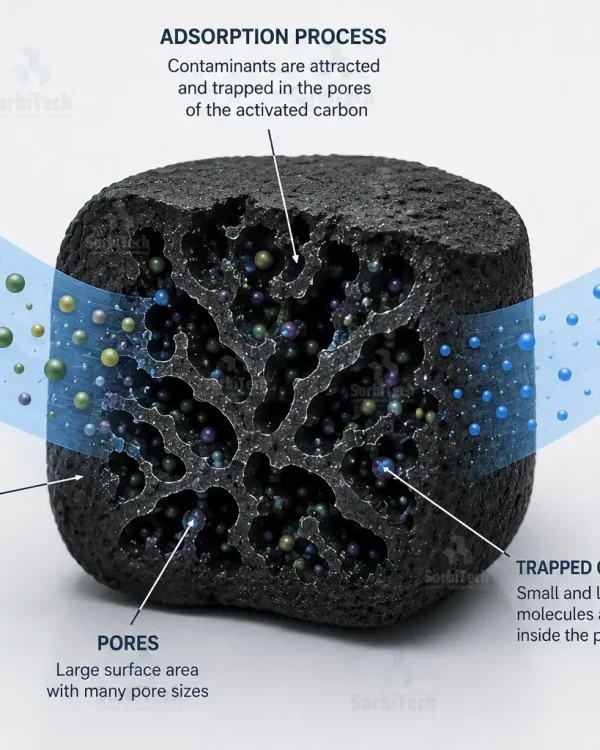
A virgin coconut shell activated carbon holds a substantial mass of most volatile organic compounds at typical industrial vent conditions. Toluene and xylene, both common in coating and resin operations, load at 20 to 35 percent by mass on a fresh bed operating at 20 to 30 degrees Celsius and 40 percent relative humidity. Methyl ethyl ketone loads at 15 to 25 percent. Methanol, being highly polar and having strong water affinity, loads at only 5 to 10 percent under the same conditions. Formaldehyde is a special case: its low equilibrium loading on virgin carbon means most formaldehyde compliance systems use a caustic or amine impregnated activated carbon grade rather than a straight physical adsorbent, and the reagent chemistry behind that choice is set out under impregnated activated carbon chemistry across the four industrial reagent loadings.
Design equilibrium loading is always lower than the peak fresh carbon capacity. Plants that specify a bed against the peak capacity number end up with an unpleasant surprise around the first replacement cycle when the actual breakthrough time falls below expectations. The working capacity, typically 60 to 75 percent of the equilibrium value, is the number that belongs in the sizing calculation. Working capacity accounts for the fact that adsorption is never fully complete before the outlet concentration begins to rise, and the system operator triggers a bed changeout well before the theoretical saturation point.
Bed and Canister Layouts for Permit Limited Exhaust
Three physical layouts dominate VOC compliance installations. The first is a single vessel fixed bed with periodic replacement. This is the simplest and the most common at smaller facilities, using a granular activated carbon canister for smaller vessel duties and switching to pellet grades once the flow rate makes pressure drop the dominant operating cost. The second layout is a two vessel arrangement with one bed on duty and one bed on standby, allowing online swap over when the duty bed reaches its outlet trigger. This layout suits continuous production and permits that carry a strict outlet limit with no tolerance for a spike during changeover.
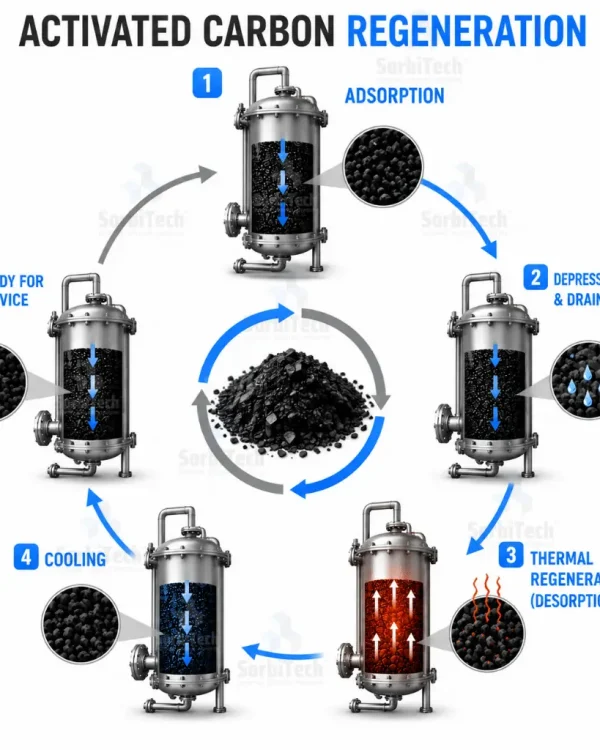
The third layout is a regenerative arrangement, where two or more beds cycle between adsorption and thermal or steam desorption. Regenerative systems recover both the carbon and, in most cases, the solvent, and they suit high throughput continuous vent streams where the economics of solvent recovery justify the higher capital cost. The regenerative layout shares its equipment train with solvent recovery installations, though the design intent is different: a compliance system releases the desorbed vapour to a downstream oxidiser or condenser, whereas a twin bed activated carbon recovery train handling industrial off gas recovers the vapour as a saleable liquid.
Sizing for Continuous Emissions and for Batch Peaks
The sizing calculation for a VOC compliance bed depends on the operating pattern. A continuous emission source delivers a steady mass of volatile organic compound per hour, and the bed is sized to hold that mass for the desired service life at the design working capacity. A batch source delivers pulses of vapour that arrive with a much higher instantaneous concentration than the time averaged rate. Sizing a bed against the time averaged rate alone leaves the bed undersized for the peak, and outlet spikes can occur during the reactor purge or the tank filling event that produces the pulse.
A correctly sized compliance bed for a batch source is sized against the mass loading of the peak event, with the bed geometry allowing enough contact time at the peak flow to hold the outlet concentration below the permit limit for the duration of the pulse. Empty bed contact time for VOC compliance duty typically sits in the range of 1 to 2 seconds at design flow. Beds designed for extended service life at high loading may run longer contact times, up to 4 seconds, at the expense of vessel size.
Spent Carbon Handling and Reactivation
Spent carbon from a VOC compliance bed carries the adsorbed volatile organic compounds that it removed from the exhaust stream. In many jurisdictions this makes the spent material a regulated waste stream, and the plant permit typically requires that spent carbon be removed by a licensed contractor and either incinerated with heat recovery or thermally reactivated at a dedicated facility. Reactivation restores 85 to 95 percent of the original micropore volume and returns the carbon to the market as reactivated grade material, at a substantially lower cost per tonne than virgin carbon. The economics of reactivation compared with landfill disposal favour reactivation for larger plants generating more than a few tonnes of spent carbon per year. Deeper background on thermal reactivation of spent activated carbon covers the kiln stages, the mass balance across each stage, and the loss per cycle that determines how many reactivation rounds are economic.
Emission Monitoring and Record Keeping
A compliance system without a defensible record trail leaves the plant exposed at the next regulatory audit. Continuous emission monitoring systems on the bed outlet, with data logged at the specified reporting frequency, are the primary evidence base. Manual sampling to a written procedure, with results retained in the site quality management system, is the fallback where continuous monitoring is not required by permit. In both cases, the frequency, the calibration schedule, the analyser make and model, the log of any alarms, and the log of any bed replacement events all belong in the record. Plants that keep this record complete and readily available typically pass regulatory inspections with only minor findings; plants that do not typically face requests for additional data that consume operating time.
Plant integration detail and vessel selection guidance for each layout sit alongside industrial VOC removal duty. Regional supply into Sohar industrial estate and the wider Omani downstream cluster covers both the standard virgin coconut shell grade and the impregnated grades used in specialty compliance duty.
| Compliance parameter | What to establish | Typical treatment |
|---|---|---|
| Permit listed compounds | Named substances and their individual limits | Reference for grade selection |
| Total VOC or TOC limit | Combined limit as equivalent methane, hexane, or carbon | Overall bed sizing constraint |
| Monitoring point and frequency | Stack, fenceline, continuous, hourly, daily | Determines analyser and logging |
| Averaging period | Instantaneous, hourly, daily, monthly | Determines tolerance for peaks |
| Reporting frequency | Continuous submission, monthly, quarterly | Determines record structure |
| Bed layout | Single, twin, or regenerative | Determines swap over capability |
| Design working capacity | 60 to 75 percent of peak equilibrium loading | Bed sizing input |
| Spent carbon route | Reactivation, incineration, or licensed disposal | Waste manifest and cost input |
Compliance note. A regulatory finding that spent carbon has been treated as general waste rather than as a listed regulated waste stream is a more common source of enforcement action in the Gulf industrial sector than a bed outlet exceedance itself. The waste chain of custody, from the plant to the licensed treatment facility, has to be documented for every drum leaving site.
SorbiTech Group Portfolio
Activated Carbon Dubai supplies both virgin and reactivated activated carbon into VOC compliance installations across the Gulf under the SorbiTech™ Group portfolio. Regional supply into Sohar, Ruwais, Jubail, and Yanbu petrochemical clusters is served from the Dubai and Sohar warehouses, with lead times supporting both scheduled turnaround loadings and hot standby replenishment. The group's wider industrial adsorbent range covers gas treatment, process water, and pharmaceutical duty, complemented by Medaad Adsorption Chemicals for adjacent adsorption chemistries.
Technical enquiries for activated carbon for VOC emission compliance, bed sizing against a specific permit condition, or spent carbon logistics can be raised through Contact Us.