Activated carbon solvent recovery installations turn a compliance problem into a revenue stream. Any industrial process that uses volatile organic solvents in significant quantity, whether a printing line running toluene inks, a coating line running methyl ethyl ketone, a rubber cement line running hexane, or a pharmaceutical process running ethyl acetate, produces an off gas stream that carries a substantial mass of solvent per hour. The choice for the plant operator is either to send that solvent to a thermal oxidiser and pay the fuel cost to destroy it, or to catch it on activated carbon, desorb it with steam, condense the desorbed vapour, and return the recovered solvent to the process as feed. Recovery inverts the economics of the emission control stage: the carbon system pays for itself out of the value of the recovered solvent, and often generates net positive cash flow across its operating life. Where the vent stream concentration is too low for recovery to pay back, the same equipment train doubles as a compliance system for activated carbon VOC emission control at industrial facilities. Wider gas phase selection background, before the recovery framing enters the discussion, sits with activated carbon selection for air and gas purification.
Why Solvent Value Drives the Recovery Decision
The economic case for solvent recovery is direct. A plant venting 100 kilograms per hour of toluene at the current landed cost of industrial toluene in the Gulf market is discharging several hundred US dollars per hour of raw material to atmosphere. Over a year of continuous operation, that is millions of dollars of solvent that would otherwise have to be repurchased at the reactor gate. Even after the capital cost of a twin bed recovery system, the steam cost of the desorption cycle, and the operating cost of the condenser and separator, the payback window on solvent recovery for streams containing more than around 500 to 1000 parts per million by volume of organic solvent is typically 18 to 36 months. Below that concentration range, direct compliance destruction usually wins on economics.
The value case is strongest where the recovered solvent goes straight back into the same process without needing further purification. Printing and coating lines, where the recovered solvent returns to the ink or paint mixing kitchen, sit at the top of the value case. Pharmaceutical processes, where the recovered solvent has to meet a tight impurity specification before it can be used again, sit lower because the polishing stage after recovery adds cost. The plant that considers recovery has to walk the recovered stream back to the point of reuse and confirm the purity meets the input specification of that reuse point.
Activated Carbon Solvent Recovery: Twin Bed Operation
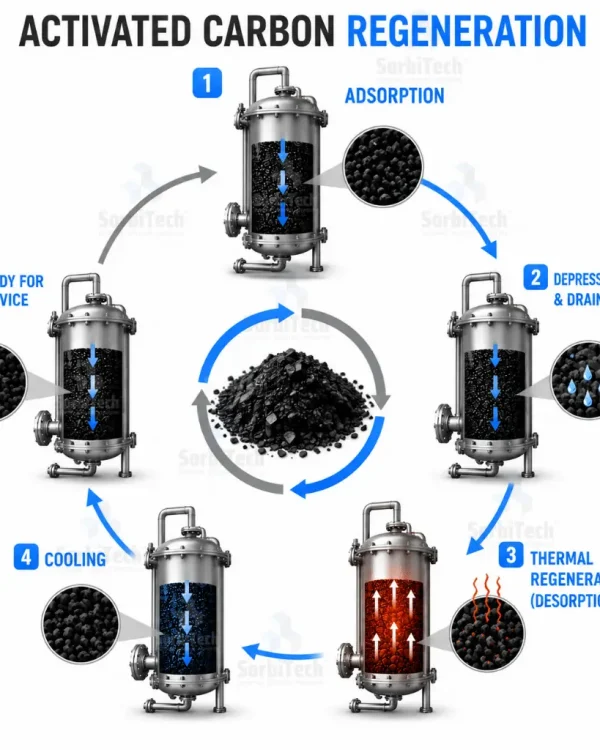
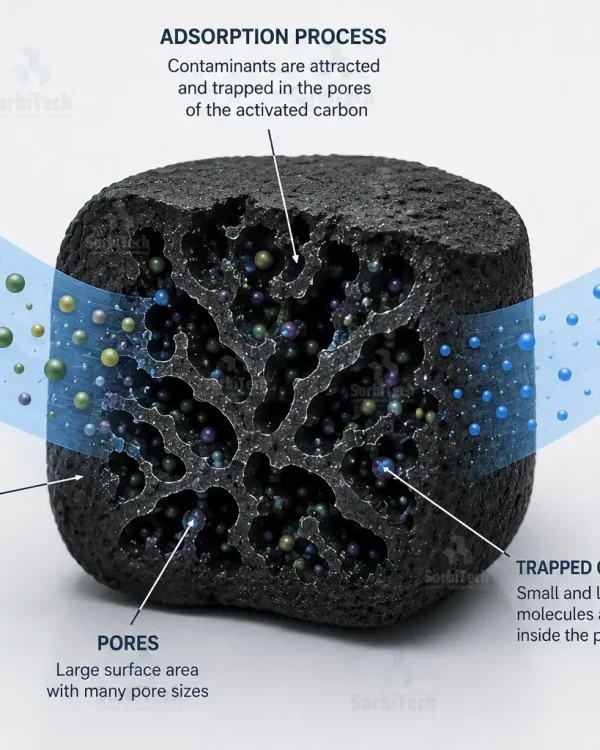
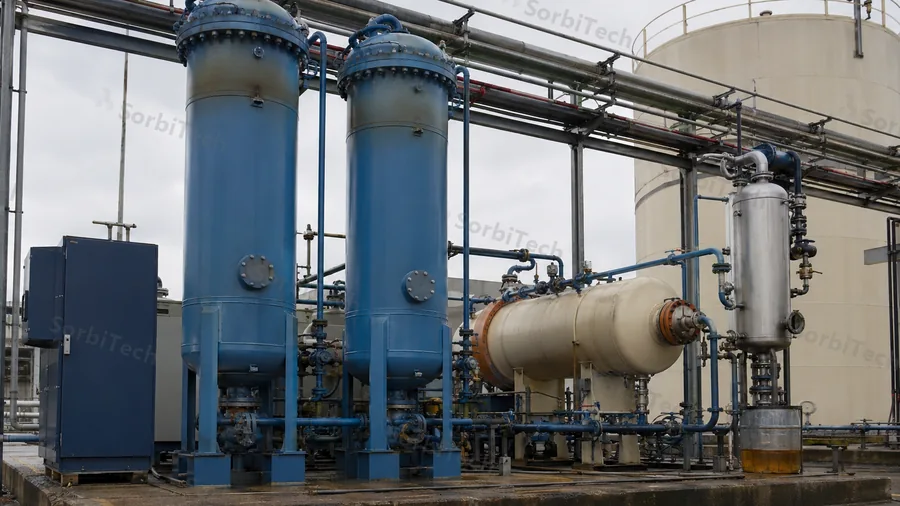
The workhorse layout for continuous solvent recovery is the twin bed arrangement. One bed is on adsorption duty, receiving the solvent laden vent stream and holding the solvent inside its pore structure. The other bed is in the desorption phase, receiving low pressure steam that displaces the loaded solvent from the pore surface and carries it out of the vessel as a mixed vapour stream. The two beds swap duty on a fixed cycle, typically every 4 to 8 hours depending on the solvent loading and the design working capacity.
The desorbed vapour leaves the desorption vessel as a mixture of solvent, water vapour, and noncondensable gas. A condenser cools the mixture below the dew point, producing a liquid stream that goes to a decanter. In the decanter, the solvent phase separates from the water phase by density difference. Water immiscible solvents such as toluene, xylene, and methyl tert butyl ether separate cleanly and the recovered solvent is drawn off as an upper or lower phase depending on its density. Water miscible solvents such as ethanol, methanol, and acetone require an additional distillation stage to separate them from the water fraction.
Between the desorption phase and the return to adsorption, the freshly desorbed bed carries residual heat and residual moisture. A cooling stage using dry air or nitrogen brings the bed back to the working temperature and reduces the moisture load before the bed comes back into adsorption service. Skipping the cooling stage leaves the bed hot and wet, and the next adsorption cycle starts with reduced capacity. Older installations that omitted the cooling stage generally show poor recovered mass balance and shortened bed life; newer designs include it as standard.
Steam Desorption and Condensate Handling
The steam side of a solvent recovery system carries as much engineering significance as the adsorption side. Desorption typically uses low pressure saturated steam at 1 to 3 bar gauge, delivering a temperature at the bed of 100 to 130 degrees Celsius. That temperature is high enough to release almost all of the loaded solvent within a defined cycle time, typically 60 to 180 minutes for a full desorption. The steam consumption per unit mass of recovered solvent depends heavily on the solvent and the loading, but a working number for a coconut shell bed on toluene at 20 percent loading is roughly 2 to 4 kilograms of steam per kilogram of solvent recovered.
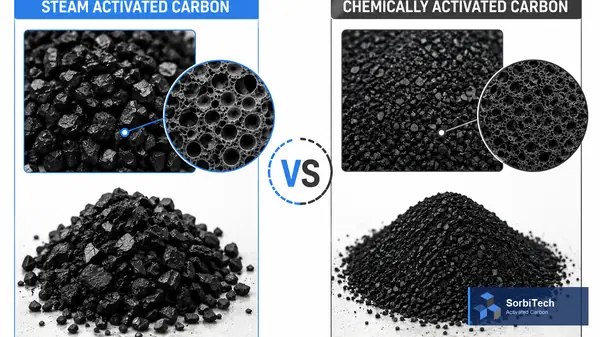
The condensate carries the recovered solvent plus a variable fraction of water. The condenser is normally a shell and tube exchanger cooled by process water or by chilled water in warmer climates. Chilled water is common in Gulf installations because the process water supply itself is warm during the summer months, and the extra cooling capacity is needed to drop the condensate below the dew point of the mixture. Steam activated carbon feedstock is the natural fit for the base carbon in recovery service, because the steam activation process produces a pore structure and mechanical strength profile that tolerates repeated thermal cycling far better than chemically activated wood carbon does.
Water Miscible Versus Water Immiscible Solvents
The recovered solvent stream splits along the water miscibility line. Water immiscible solvents such as toluene, xylene, hexane, methyl tert butyl ether, and most halogenated species separate spontaneously in the decanter and can be drawn off directly as a wet organic phase. A residual moisture content of 100 to 500 parts per million typically remains in the organic phase after decantation and is either accepted by the downstream reuse point or removed by a molecular drying step. Water miscible solvents such as ethanol, methanol, isopropanol, and acetone form a single phase with the condensed water and require a downstream distillation column to concentrate them back to specification.
The economic penalty of distilling a water miscible solvent back to specification is the reason why plants running these solvents sometimes prefer nitrogen swept desorption rather than steam. A dry nitrogen sweep at 120 to 150 degrees Celsius desorbs the solvent as a dry vapour, which condenses directly to a solvent phase with no water dilution. The nitrogen sweep costs more in energy and equipment complexity than steam desorption but eliminates the distillation cost downstream. The choice between the two routes is normally a straightforward comparison of net operating cost across the expected plant life.
Carbon Life Under Repeated Thermal Cycling
Solvent recovery beds see between 500 and 2000 full thermal cycles across their operating life, depending on the cycle length and the annual operating hours. Each cycle takes the carbon from working temperature up to steam desorption temperature and back down to working temperature. Repeated thermal cycling gradually degrades the pore structure of any activated carbon, but the rate of degradation depends heavily on the base carbon selection. Hard, dense coconut shell base carbon tolerates 2000 cycles or more without significant capacity loss. Softer coal based grades typically lose capacity earlier. Chemically activated wood carbon is not usually specified for recovery duty because its lower mechanical strength and higher initial ash content produce accelerated attrition under repeated cycling. When capacity does fall below the operating threshold, thermal reactivation restores most of the original working capacity. The thermal reactivation of spent carbon process for recovery beds follows the same kiln stages as reactivation of any spent carbon, though the loaded species and the residual moisture profile are more consistent from batch to batch than for a general spent carbon stream.
Payback Windows in GCC Industrial Context
The economics of solvent recovery in the Gulf industrial sector track the same general drivers as elsewhere but with local twists. Solvent landed cost is generally lower than in Europe because of shorter logistics chains from Middle East petrochemical production. Steam cost is generally comparable, as most large industrial facilities generate their own low pressure steam. Chilled water cost is higher because of the warmer ambient. Labour cost for operations and maintenance is lower. On balance, the payback window for a mid sized closed loop solvent recovery installation is broadly similar to a comparable installation in Europe, typically 24 to 36 months for continuous processes above the 500 parts per million by volume solvent concentration threshold.
Specific Gulf industrial clusters that support solvent recovery installations at scale include the Jebel Ali specialty chemicals area in Dubai and the Yanbu industrial city on the Red Sea coast of Saudi Arabia. Both hubs contain the mix of coating, printing, and specialty chemical operations that make solvent recovery economically attractive, and both have the local infrastructure to support the steam, chilled water, and utility loads of a well integrated recovery system.
Design observation. The single most common design error in a first time solvent recovery installation is undersizing the condenser and decanter for the summer envelope. A condenser sized against a moderate ambient temperature will fail to drop the condensate below the dew point on the hottest summer days, allowing solvent vapour to break through to the vent and reducing the recovered mass. Chilled water sizing at the recovery train is worth doing carefully against the 99th percentile summer day, not the design year average.
SorbiTech Group Portfolio
Activated Carbon Dubai supplies steam activated coconut shell carbon and coal based recovery grades into solvent recovery installations across the Gulf under the SorbiTech™ Group portfolio. Standard recovery grades are stocked in pellet grade carbon for solvent duty in 3 mm and 4 mm diameter, alongside granular grades for smaller installations. The wider industrial adsorbent portfolio covers upstream vent air treatment and downstream polishing, complemented by Medaad Adsorption Chemicals for adjacent purification duties.
Technical enquiries for activated carbon solvent recovery grade selection, bed sizing for a specific solvent, or payback analysis for a new installation can be raised through Contact Us.