Municipal water treatment in the Middle East draws on two very different raw water sources and delivers to consumers in one of the hottest climates on earth. Between the intake and the household tap, activated carbon works as one of the most reliable barriers against chlorine residuals, disinfection by products, taste and odor compounds, and trace organic contaminants.
This guide walks through the role that activated carbon plays across a typical Middle East municipal treatment train, the grades that suit each duty, and the operational factors that shape how it performs across the region.
Water Sources Across the Middle East
Municipal water supply across the region draws heavily on two feedwater types. Coastal cities in the Gulf Cooperation Council depend on desalinated seawater produced through reverse osmosis or thermal desalination. Inland cities and smaller distribution zones rely more on treated groundwater from confined aquifers, sometimes blended with desalinated water to meet total demand.
Both feedwaters carry trace contaminants that reverse osmosis membranes and conventional media filters do not always eliminate at the concentrations that potable supply requires. That is where activated carbon filtration earns its place in the treatment chain.
What Activated Carbon Removes in Municipal Water
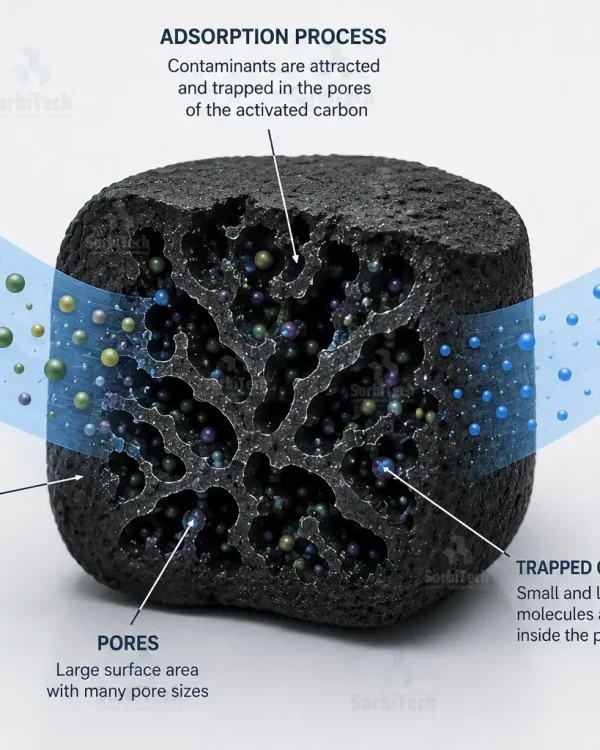
The value of activated carbon in water treatment lies in its very high internal surface area. Coconut shell grades typically deliver between 900 and 1,200 square meters per gram, while chemically activated wood grades can go higher. Contaminants are trapped inside the microporous structure through physical adsorption, without chemical dosing into the treated water.
In a Middle East municipal context, the contaminants of primary concern include:
- Free chlorine and chloramines introduced during upstream disinfection. Carbon reduces these to chloride ions before the water enters the distribution network, preventing taste complaints and pipe material degradation.
- Trihalomethanes and other disinfection by products that form when chlorine reacts with organic precursors, particularly during warm season conditions.
- Dissolved organics such as total organic carbon, responsible for musty and earthy taste and odor. The most common culprits are 2 methylisoborneol and geosmin, released by cyanobacteria in warm coastal water.
- Algal toxins such as microcystins, seasonally present in Arabian Gulf source water and closely monitored across the region.
- Trace hydrocarbons that can enter shallow groundwater from surface infrastructure.
Where Activated Carbon Fits in a Municipal Plant
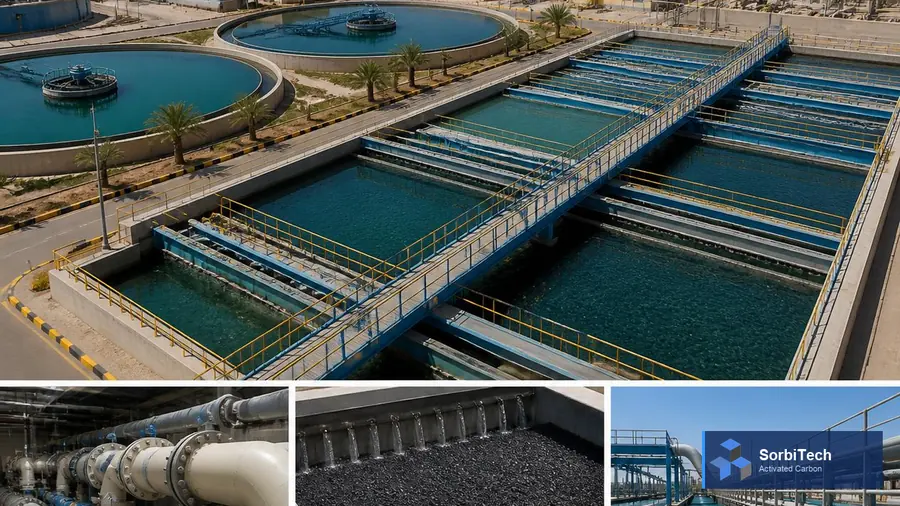
Across Middle East municipal facilities, activated carbon for drinking water is deployed at one of three points, and often at more than one.
Post desalination polishing. After reverse osmosis or thermal desalination, granular activated carbon removes residual chlorine that would otherwise damage downstream ion exchange resin and attack distribution system elastomers. It also captures trace organics that carried through the membrane.
Coagulation and sedimentation adjunct. Powdered activated carbon is dosed as a slurry into the coagulation stage during algal bloom episodes, delivering a targeted response to spikes in taste and odor compounds without permanently modifying the plant.
Blending station and reservoir polishing. Where treated water is blended before entering the distribution grid, a granular activated carbon vessel removes taste and odor precursors and any residual disinfectant, so water reaches consumers at the expected quality.
Choosing the Right Carbon Grade
The three main forms of carbon used in municipal treatment behave differently, and the choice between them is driven by the duty rather than by preference.
Granular Carbon in Middle East Municipal Plants
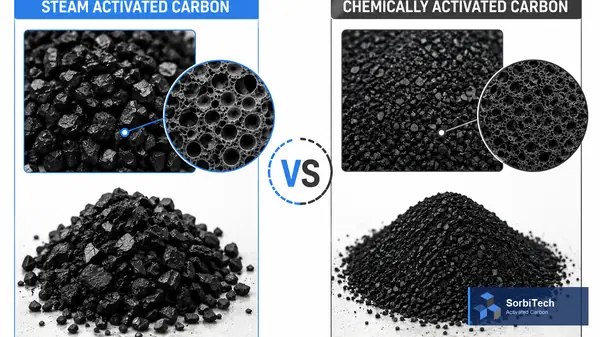
Granular activated carbon is used in fixed bed vessels for continuous duty polishing, and it is the workhorse of the majority of GCC potable water sites. In coastal Saudi Arabia and along the UAE eastern coast, coconut shell granular carbon is often the first choice for post desalination polishing because of its hardness, low ash content, and high iodine number. Inland plants in the region, where the feed is a groundwater and desalinated blend with higher organic loading, more often move to coal based granular carbon for its broader pore structure. Deeper technical background on matching the grade to the duty is set out in the guide on choosing the right activated carbon for water treatment.
Powdered Carbon for Seasonal Bloom Response Across the Region
Powdered activated carbon is dosed as a slurry into the coagulation and sedimentation stage during algal bloom periods, which for Arabian Gulf sites tend to peak between late summer and early autumn. Because the carbon is applied only when needed and removed with the settled sludge, municipal operators from Kuwait through to Oman use it as a rapid, low capital response to seasonal spikes in taste and odor compounds. Wood based powdered carbon is often preferred for this duty because its mesopore rich structure suits the larger organic molecules involved.
Impregnated Grades in Regional Water Duty
Impregnated activated carbon adds a chemical modifier to the base carbon to target specific contaminants. In regional reservoir applications where residence time is long and biofilm can develop on the bed itself, silver impregnated granular carbon is sometimes deployed to suppress bacterial regrowth. Potassium hydroxide impregnation shifts the surface chemistry toward acidic gas removal, which is more common in industrial rather than municipal water duty.
Specifications That Shape Performance
When procuring activated carbon for a Middle East municipal plant, the following technical properties should be verified against the plant duty. The values below are typical acceptance ranges that suit municipal water applications and should always be matched to the specific hydraulic and contaminant profile.
| Specification | Post Desal GAC | Coagulation PAC |
|---|---|---|
| Iodine Number (mg/g) | 1000 to 1200 | 800 to 1050 |
| Methylene Blue (mg/g) | above 200 | above 180 |
| Hardness (%) | above 95 | not applicable |
| Ash content (%) | below 5 | below 7 |
| Moisture on delivery (%) | below 5 | below 10 |
| Mesh or particle size | 8 by 30 or 12 by 40 | 200 mesh, under 0.18 mm |
| pH of aqueous extract | 6 to 9 | 6 to 9 |
Iodine number is a rapid indicator of adsorption capacity for small molecule contaminants such as chlorine and low molecular weight organics. Methylene blue tracks capacity for larger molecules including taste and odor compounds. Hardness governs how much mechanical stress the carbon can take during backwashing without generating fines. Ash content matters in potable duty because high ash grades can raise the pH of low mineral desalinated water passing through the bed.
Operational Considerations in a Hot Climate
Municipal plants across the region operate under conditions that shape carbon performance predictably.
Temperature. Feedwater temperatures above 35 degrees Celsius reduce equilibrium adsorption capacity for many organic contaminants by around 10 to 20 percent compared with 25 degrees. Sizing the carbon bed against summer conditions rather than annual averages avoids surprises during peak load months.
Upstream chlorine dose. Higher upstream chlorination extends microbial safety in long transmission pipelines but shortens the useful life of the polishing bed, because chlorine reduction consumes carbon reactivity stoichiometrically.
Post desalination water quality. Very low total dissolved solids in post reverse osmosis water can be aggressive toward carbon fines. Thorough backwashing before service reduces initial turbidity spikes. The same consideration applies where treated municipal water is drawn off for industrial process water polishing.
Bloom seasonality. Warm water bloom events in the Arabian Gulf have become more frequent over the past decade. Keeping a strategic reserve of powdered carbon on site allows a coagulation stage dose to be applied within hours of a laboratory alert, rather than waiting for a shipment to arrive.
Monitoring and Replacement
Carbon in a fixed bed reaches breakthrough when the outlet concentration of the target contaminant rises to a defined percentage of the inlet, typically 5 to 10 percent. Reliable monitoring includes:
- Free chlorine on the inlet and outlet of the polishing vessel, ideally with automatic sampling.
- Periodic total organic carbon measurement, to catch slow organic breakthrough that chlorine readings alone would miss.
- Differential pressure across the bed, which will rise as the carbon compacts and suspended solids accumulate.
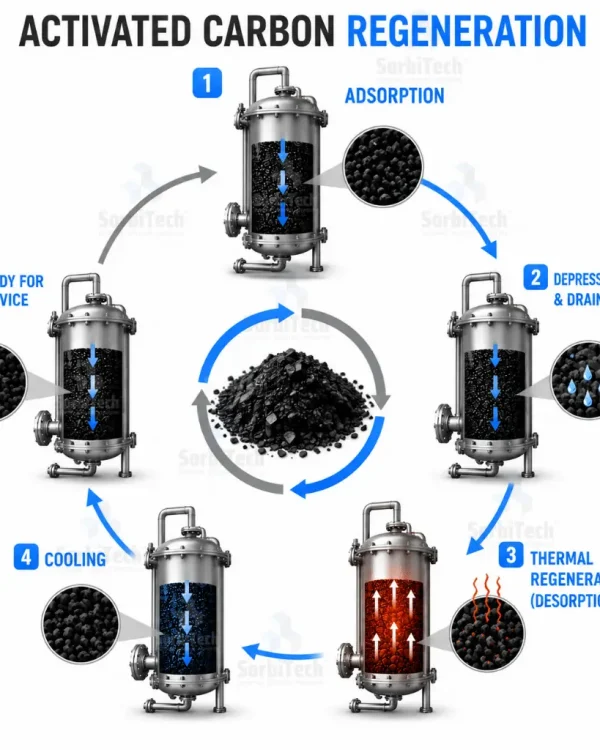
Spent carbon can often be sent for thermal or steam regeneration rather than disposed of directly, recovering a large fraction of the original capacity at a fraction of the cost of virgin material. Regeneration also lowers the environmental footprint of the treatment plant.
Operational note. Extending carbon service life beyond breakthrough to save on replacement cost often leads to taste complaints and elevated by product concentrations at the tap. Replacing on schedule protects both water quality and the operator reputation.
Regional Variations Across the Middle East
While the treatment principles are similar across the region, source water chemistry and demand patterns vary. Municipal water treatment in Saudi Arabia involves large scale desalination plants along both the Red Sea and Arabian Gulf coasts, with significant transmission distances into central cities. Qatar and Kuwait operate compact, high throughput coastal facilities. Oman and Bahrain combine desalinated and groundwater blending strategies. Understanding the local water profile is the starting point for selecting a carbon grade that will perform through the seasonal cycle.
Supply and Engineering Support Across the Region
Municipal water treatment specifiers and EPC contractors in the region can consult the SorbiTech engineering team on grade selection, bed sizing, replacement scheduling, and slurry dosing for algal bloom response. Enquiries can be raised through Contact Us, and broader technical background is set out on how activated carbon works.
SorbiTech Carbon is part of the SorbiTech™ Group, whose portfolio also includes adsorption and purification chemistries developed by Medaad Adsorption Chemicals. Together, they support water, gas, and industrial process treatment programmes across the Middle East and beyond.