Selecting the right activated carbon for gold recovery is one of the most consequential decisions in gold processing. The carbon introduced into a CIL, CIP, or CIC circuit directly determines gold loading efficiency, carbon consumption rates, and overall recovery economics. A poor selection leads to gold losses in tailings, excessive carbon breakage, and higher operating costs per ounce recovered. This guide explains the technical parameters, raw material considerations, and evaluation criteria that process engineers should assess before sourcing gold recovery carbon for their operations.
Why Carbon Quality Matters in Gold Recovery
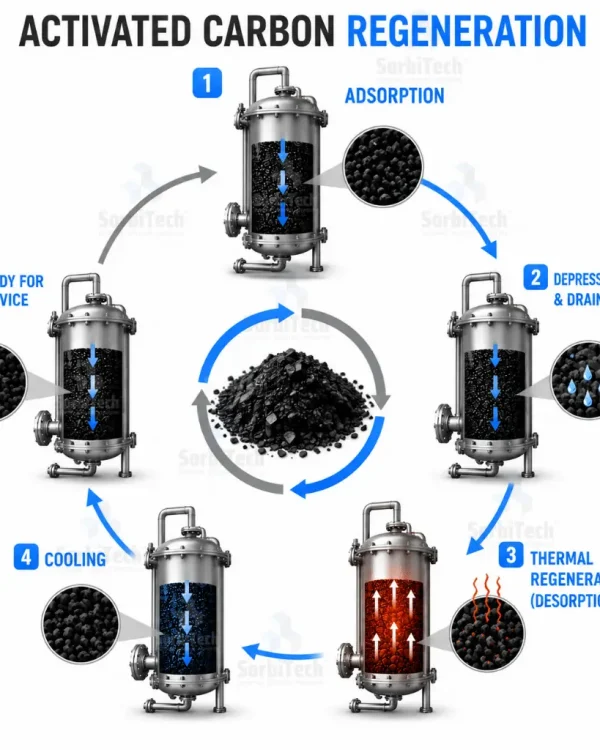
Activated carbon in gold recovery circuits operates under conditions that are far more aggressive than most other industrial applications. The carbon sits in abrasive ore slurry, withstands temperatures above 110 degrees Celsius during elution, and undergoes thermal reactivation at 650 to 850 degrees Celsius after every loading cycle. A single batch of carbon may go through 50 to 100 of these reactivation cycles before it is consumed beyond usefulness.
When carbon breaks down under these conditions, the resulting fine particles carry adsorbed gold out of the circuit through the screens. This gold loss is unrecoverable. If the carbon loads gold too slowly, dissolved gold passes through the circuit and reports to the tailings dam. Both scenarios directly reduce the amount of gold recovered from each tonne of ore processed. The difference between a well selected carbon and a poorly selected one can represent millions of dollars over a single year of operation at a mid scale mine.
How Gold Recovery Circuits Use Activated Carbon
Understanding how activated carbon gold recovery works starts with the three main circuit configurations used in modern gold processing. Each circuit type places different physical and chemical demands on the carbon, and these demands should influence your carbon selection.
| Circuit Type | How It Works | Key Demand on Carbon |
|---|---|---|
| Carbon in Leach (CIL) | Carbon is added directly into the leach tanks where cyanide dissolution of gold is still taking place. The carbon competes with the ore for dissolved gold. | Fast adsorption kinetics (high R value) to capture gold before it can re-adsorb onto ore surfaces or organic matter in the pulp. |
| Carbon in Pulp (CIP) | Leaching is completed first. Carbon is then introduced into separate tanks to adsorb gold from the pre-leached slurry. | High loading capacity (high K value) and strong abrasion resistance, since the carbon moves counter-current through multiple tanks of dense slurry. |
| Carbon in Column (CIC) | Clarified, pregnant solution (no solids) passes through fixed or fluidized beds of carbon in vertical columns. | Consistent particle size distribution and low fines generation to maintain solution flow through the column bed. |
Most large scale gold operations run CIL or CIP circuits, where the carbon is in direct contact with abrasive ore pulp. These circuits demand carbon with high mechanical strength and fast adsorption rates. CIC circuits, commonly used in heap leach operations, are less physically demanding but require carbon with uniform sizing to avoid channeling and pressure buildup in the columns.
Key Specifications for Gold Recovery Carbon
When evaluating gold recovery carbon specifications, there are several measurable parameters that indicate whether a carbon product will perform reliably in a gold circuit. The table below lists the most important ones and explains what each specification tells you about the carbon.
| Specification | What It Measures | Target Range | Why It Matters |
|---|---|---|---|
| Iodine Number (mg/g) | Total micropore volume available for adsorption | Above 1050 | Higher iodine number generally indicates more adsorption sites for gold cyanide complexes |
| K Value (Activity) | Equilibrium gold loading capacity | Higher is better | Determines how much gold the carbon can hold at full saturation. Directly affects the gold concentration on loaded carbon. |
| R Value (Kinetics) | Rate at which the carbon adsorbs gold from solution | Higher is better | Faster adsorption reduces the residence time needed and lowers the risk of gold passing through the circuit |
| Abrasion Number (%) | Resistance to mechanical wear from tumbling in slurry | Above 97 | Low abrasion resistance means rapid fines generation and gold losses through the screens |
| Ball Pan Hardness (%) | Resistance to crushing and impact forces | Above 97 | Weak carbon fractures during inter-stage pumping and screen contact |
| Ash Content (%) | Inorganic mineral residue in the carbon | Below 4 | High ash reduces the number of available adsorption sites and can affect smelting purity |
| Moisture (%) | Water content at time of delivery | Below 5 | Affects accurate weight-based inventory management and transport costs |
| Particle Size | Physical dimensions of the carbon granules | 6×12 or 6×16 mesh | Must match the screen apertures in the circuit. Oversized carbon reduces flow; undersized passes through screens. |
The K and R values together give the most complete picture of how a carbon will behave in a gold circuit. A carbon with a high K value but low R value can hold a lot of gold but takes a long time to reach saturation. In a CIL circuit where residence time is limited, the R value often matters more than the K value. SorbiTech manufactures OraPure activated carbon with both K and R values engineered for the specific conditions of gold cyanidation circuits.
Why Coconut Shell Carbon is Preferred for Gold Recovery
The raw material used to manufacture activated carbon determines its pore structure, hardness, and overall suitability for gold recovery. Coconut shell activated carbon has become the standard material for gold processing worldwide, and the reasons are rooted in the physical properties of the material itself.
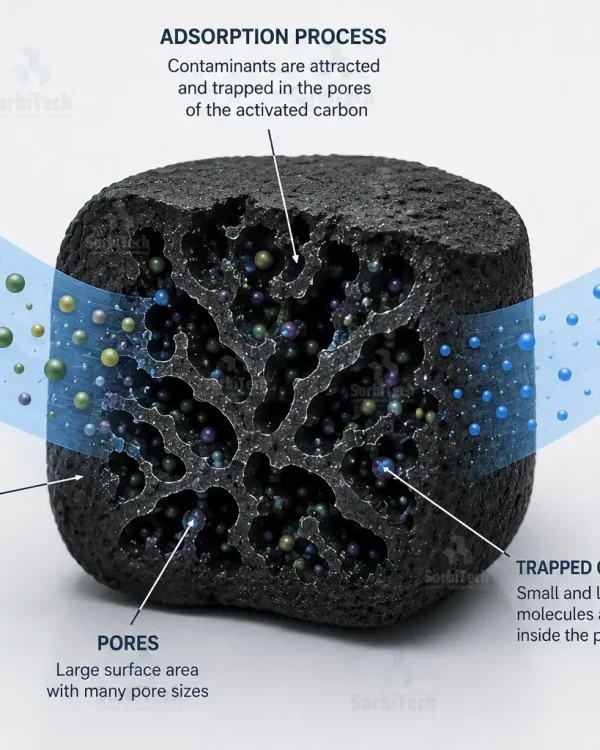
Coconut shell based activated carbon has a naturally high density and a well developed micropore structure that is ideal for adsorbing gold cyanide complexes. The hard, dense shell material produces carbon granules with abrasion numbers consistently above 97 percent, which means the carbon retains its particle size through many reactivation cycles. This translates directly into lower fines losses and better gold recovery over the working life of the carbon inventory.
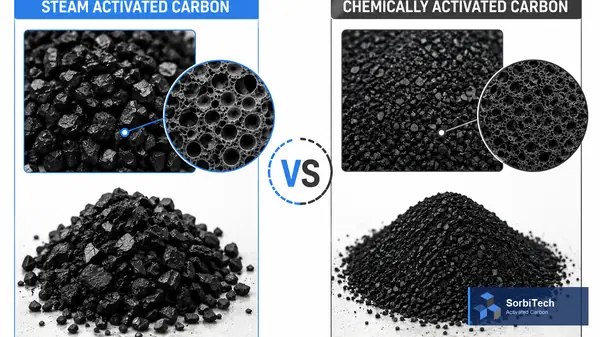
Coal based activated carbon is sometimes considered as a lower cost alternative for gold recovery. While coal based products can offer adequate iodine numbers, they typically have lower hardness and abrasion resistance compared to coconut shell carbon. In a demanding CIL or CIP circuit, coal based carbon degrades faster, produces more fines, and needs to be replaced more frequently. When the cost of gold lost in fines and the higher replacement frequency are factored in, the initial cost saving often disappears.
Palm kernel shell activated carbon represents another raw material option that some operations have evaluated. Its properties sit between coconut shell and coal based carbons, and its suitability depends on the specific circuit conditions and operating parameters at each site.
How Carbon Quality Affects Operating Costs
The economic impact of carbon selection extends beyond the purchase price per kilogram. Process engineers evaluating activated carbon suppliers should consider the total cost of ownership across the full operating cycle.
| Cost Factor | Impact of Low Quality Carbon | Impact of High Quality Carbon |
|---|---|---|
| Carbon consumption (kg per tonne ore) | Higher breakage rates increase makeup carbon requirements by 20 to 40 percent | Lower breakage extends the carbon inventory life and reduces the frequency of new carbon additions |
| Gold on fines losses | Weak carbon generates fines that carry adsorbed gold through circuit screens. Losses of 0.5 to 1.5 percent of total gold production are common with low quality carbon. | Hard, abrasion resistant carbon minimizes fines generation and keeps gold losses below 0.3 percent |
| Reactivation fuel costs | Degraded carbon requires more frequent reactivation cycles, increasing kiln fuel consumption | Durable carbon maintains its activity through more cycles before reactivation is needed |
| Circuit downtime | Screen blinding from excessive fines leads to unplanned shutdowns for cleaning | Consistent particle size reduces maintenance interventions |
A practical example: at a gold mine processing 3 million tonnes of ore per year with a head grade of 1.5 grams per tonne, a 0.5 percent improvement in gold recovery represents over 220 additional ounces of gold recovered annually. At current gold prices, the value of selecting the right carbon far exceeds the price difference between low and high quality products.
What Form of Activated Carbon Works for Gold Recovery
Granular activated carbon in the 6×12 mesh size range (1.7 to 3.4 mm) is the standard form used in gold recovery circuits worldwide. This particle size is large enough to be retained on the inter-stage screens (typically 0.6 to 1.0 mm aperture) while still providing sufficient external surface area for efficient gold adsorption from solution.
Finer mesh sizes such as 8×16 or 12×40 are not suitable for CIL and CIP applications because they pass through the circuit screens. Powdered activated carbon is used in some other industrial applications like wastewater treatment, but it has no practical role in gold recovery circuits because it cannot be separated from the ore pulp by screening.
For CIC column operations processing clear solutions from heap leach pads, a slightly smaller granule size (6×16 mesh) may be used to improve solution contact and increase gold loading rates within the column.
What to Look for in a Gold Recovery Carbon Supplier
Sourcing activated carbon for gold recovery requires more than comparing prices on a quote sheet. The reliability of the activated carbon supplier directly affects your plant’s ability to maintain consistent gold production. Here are the evaluation criteria that experienced process engineers consider.
Batch to batch consistency. Gold circuits are tuned to operate with carbon that behaves predictably. If one shipment has an iodine number of 1100 and the next arrives at 950, the circuit parameters need adjustment. A reliable activated carbon manufacturer provides consistent specifications across every delivery.
Certificate of analysis with every shipment. Each delivery should include documented test results for K value, R value, abrasion number, iodine number, hardness, ash content, moisture, and particle size distribution. Without this data, you are operating blind.
Technical support. The supplier should be able to discuss circuit conditions, recommend carbon specifications based on your ore type and circuit design, and help troubleshoot adsorption or attrition issues if they arise.
Supply chain reliability. Gold mines often operate in remote locations across Africa, Central Asia, and South America. The supplier needs to demonstrate the ability to deliver consistent volumes on schedule to these locations. SorbiTech operates from the UAE and supplies OraPure activated carbon to gold mining operations across multiple continents, with logistics handled on standard Incoterms (EXW, FOB, CIF, or DDP) depending on destination requirements.
Common Mistakes When Selecting Gold Recovery Carbon
Several selection errors occur frequently across gold operations, particularly at sites where the metallurgical team does not have direct experience with carbon evaluation.
Ignoring the R value. Many carbon specifications focus on iodine number and hardness but do not report the R value. In CIL circuits with limited residence time, the adsorption rate is often the single most important parameter. A carbon with high iodine but slow kinetics will underperform a slightly lower iodine carbon that loads gold faster.
Using carbon designed for other applications. Activated carbon manufactured for water treatment or odour control has a different pore structure and activation profile than carbon engineered for gold recovery. These products may have acceptable iodine numbers but lack the specific K and R values needed for efficient gold adsorption.