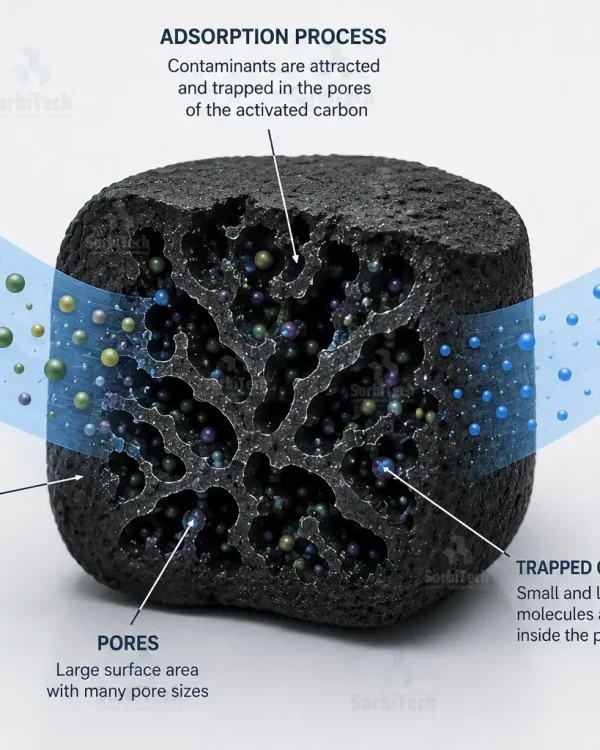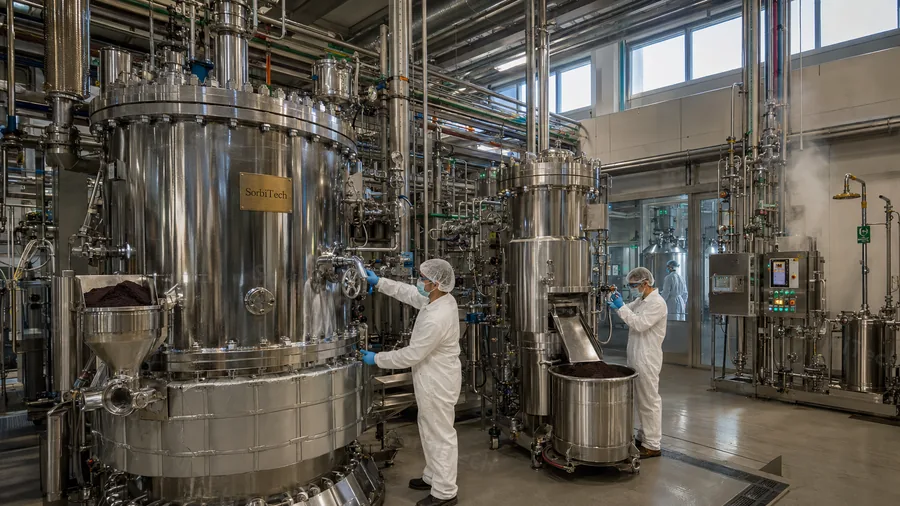
Activated carbon for pharmaceutical purification handles a set of jobs no other unit operation covers with the same combination of adsorption breadth, food and pharma grade profile, and predictable mass balance. Colour bodies, endotoxins, residual solvents, and trace catalyst species all fall within its reach. A pharmaceutical facility in Dubai producing a small volume oncology API uses a powdered carbon slurry to hit product colour specification before crystallisation. A generic drug manufacturer in Sudair uses granular carbon in a fixed bed to polish water for injection ahead of a distillation column. A contract manufacturer in the Abu Dhabi pharma cluster in KEZAD uses a wood based carbon at the primary decolourisation stage of a peptide purification. Each of these plants has its own regulatory record keeping requirement, its own crystallisation window, and its own solvent recovery expectations. The grade of carbon that fits each duty is different, and the reason each grade fits is different. The underlying physical chemistry, and the way activated carbon holds contaminants inside its micropore and mesopore structure, sits behind every grade selection decision described below.
What Activated Carbon Actually Does in a Pharmaceutical Process
Pharmaceutical processes place a stack of requirements on any material that contacts the drug substance or its solvent stream. Extractable and leachable profiles have to be characterised. Ash, heavy metals, and residual reagents from the carbon manufacture have to sit below limits that keep the drug product within its impurity specification. Batch to batch consistency has to be tight, because a pharmaceutical process is validated against a defined dosing regime and grade change requires either a bridging study or a full requalification. All of these constraints narrow the choice of carbon grade well before any adsorption performance number enters the discussion.
Within those constraints, the actual duty of the carbon is one of three things. It is either decolourisation of an API solution or intermediate, removal of pyrogenic and endotoxin material from a water or buffer stream, or polishing of a recovered solvent before that solvent goes back into the process. Each of those duties benefits from a different pore structure and a different form factor, which is why a pharmaceutical plant that runs several product lines will typically hold two or three different carbon grades in stock rather than one universal grade.
Powder or Granular: Matching Form to the Unit Operation
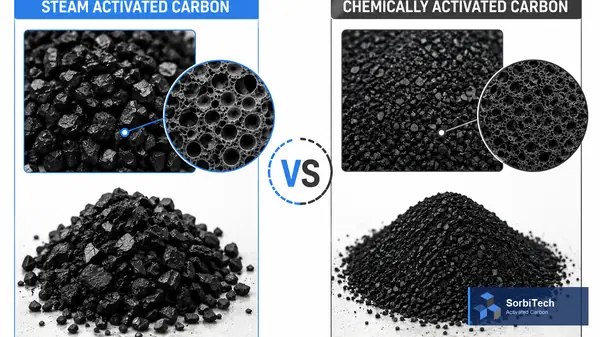
Powdered carbon dosed as an aqueous or solvent slurry is the dominant form in API decolourisation. The powder is added to a stirred vessel containing the crude API solution, held under gentle agitation for a defined contact time, and then removed with the process solids on a filter press or a bag filter. The advantage is speed and simplicity. A batch decolourisation stage using powdered activated carbon grades at a dose of 0.5 to 3 percent by mass of the dissolved substance typically reaches equilibrium in 30 to 90 minutes, which fits inside the unit operation cycle of a typical crystallisation batch.
Granular carbon in a fixed bed vessel is used where continuous polishing is preferred over batch dosing. Water for injection loops, high purity solvent recovery loops, and continuous chromatography feed conditioning all use granular fixed beds. Granular activated carbon for column duty in these applications is typically a 12 by 40 mesh coconut shell grade with tight particle size control. The advantage over powder is that the granular bed does not need a downstream filtration stage and does not shed fine particles into the treated stream, both of which matter for pharma cleanability.
Activated Carbon for Pharmaceutical Purification: Grade Specification for API Duty
API decolourisation uses a mesopore rich carbon because the target molecules are large. Coloured impurities in an API crude are typically oligomers, oxidised side products of the synthesis route, and Maillard type condensation species from any high temperature process step. These molecules span the mesopore range roughly from 2 to 50 nanometres, and a purely microporous carbon reaches only part of the distribution. Chemically activated wood based activated carbon feedstock milled to 100 or 200 mesh, with a methylene blue index above 200 milligrams per gram, is the standard specification for this duty.
Where the API is temperature sensitive, the decolourisation stage runs cold, typically below 40 degrees Celsius, and equilibrium loading falls compared with a hot decolourisation. Plants that run at low temperature accept a higher carbon dose in exchange for keeping the API stable. Where the API is thermally stable, hot decolourisation at 60 to 80 degrees Celsius reaches a higher equilibrium loading and reduces the mass of carbon consumed per batch. The choice between hot and cold operation is fixed by the API chemistry, not by the carbon itself.
Endotoxin and Pyrogen Removal
Endotoxins are lipopolysaccharide fragments shed from Gram negative bacterial cell walls. They are present in most water sources at low concentration, and they are extremely difficult to inactivate by heat or chemical means once formed. Reverse osmosis holds back the bulk. Ultrafiltration and distillation catch most of the remainder. Activated carbon sits ahead of these stages as a broad spectrum organics removal step, taking off the free organic carbon that would otherwise foul the downstream membrane or leave a residual pyrogen load in the finished water.
For water for injection preparation, a granular carbon bed on the feed side of the still typically operates at empty bed contact time of 10 to 20 minutes, which is much longer than gas phase contact but appropriate for liquid phase organics removal from a low concentration feed. The carbon itself is normally a 12 by 40 mesh coconut shell grade, chosen for its low ash and low extractable profile. Bed replacement is scheduled against total organic carbon breakthrough or against a defined operating time, whichever comes first, with plants at the Dubai Science Park pharmaceutical cluster typically running on a six monthly replacement schedule that matches their scheduled water system revalidation cycle.
Solvent Polishing Before Crystallisation
Many API syntheses recover the process solvent and reuse it batch after batch. Ethanol, methanol, tetrahydrofuran, methyl tert butyl ether, and isopropyl acetate are all commonly recovered. Recovery carries the risk that trace impurities accumulate in the solvent loop and eventually appear in the finished API. A granular carbon polishing bed on the recovered solvent line breaks that cycle. The bed catches oxidation products, coloured trace impurities, and low level extractables that survived distillation, and returns the solvent to a specification the next batch can use without introducing new impurities.
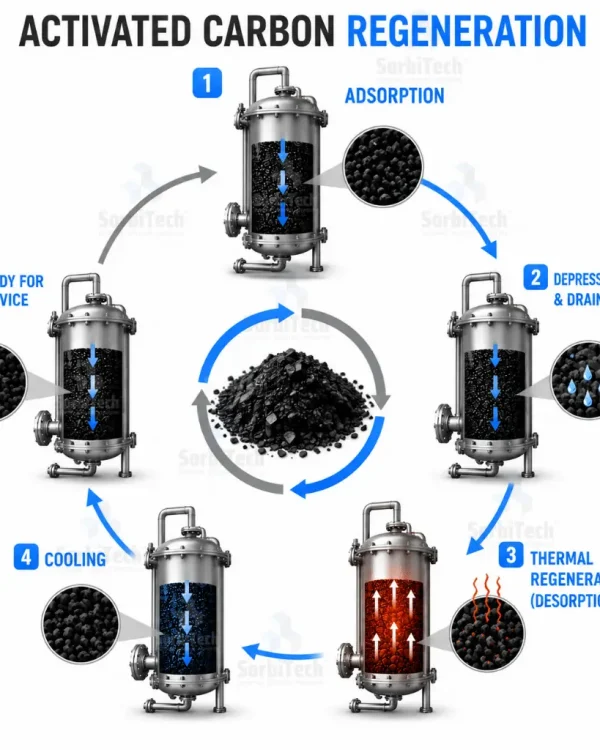
Solvent polishing beds are smaller than water for injection beds because the flow is lower. Empty bed contact time typically sits in the range of 2 to 5 minutes. The carbon is a 12 by 40 or 8 by 30 mesh coconut shell grade for polar protic solvents such as ethanol and methanol, and a broader pore coal based activated carbon for aprotic solvents that carry heavier organic impurities. Replacement is triggered by a rise in the coloured impurity reading downstream of the bed, monitored either by ultraviolet spectrometry or by a periodic offline sample. Spent carbon from these polishing beds is typically consolidated with other pharmaceutical waste streams for disposal; where the site produces sufficient volume, thermal reactivation of the spent carbon becomes a viable option, subject to segregated collection and quality management approval of the reactivated grade.
Traceability, Batch Documentation, and Audit
Every carbon grade used in a pharmaceutical process needs full lot traceability. The certificate of analysis for each drum has to carry the lot number, the manufacturing date, the raw material source, the specification results, and the results of any additional testing the plant has requested. Extractable and leachable data, heavy metals data, and residue on ignition data are common additions for pharmaceutical grades. The regulatory audit trail for the drug substance ties back to these certificates, so mixing drums across lots or losing chain of custody at the warehouse is a documented deviation that has to be closed with a full investigation.
| Pharmaceutical duty | Preferred form | Typical grade | Typical dose or contact |
|---|---|---|---|
| API decolourisation (batch) | Powdered | Wood based, chemically activated, 100 or 200 mesh, methylene blue above 200 mg/g | 0.5 to 3 percent by mass, 30 to 90 min |
| Water for injection feed polishing | Granular | Coconut shell, 12 by 40 mesh, low ash | Empty bed contact time 10 to 20 min |
| Solvent recovery polishing (polar) | Granular | Coconut shell, 8 by 30 or 12 by 40 mesh | Empty bed contact time 2 to 5 min |
| Solvent recovery polishing (aprotic) | Granular | Coal based or wood based, broader pore distribution | Empty bed contact time 2 to 5 min |
| Peptide or biologic decolourisation | Powdered | Wood based, methylene blue above 250 mg/g | 1 to 5 percent by mass, cold slurry |
| Traceability requirement | All grades | Full certificate of analysis per lot | Retained samples per drum |
Regional note. The pharmaceutical clusters at JAFZA in Dubai, Sudair Pharma City in Saudi Arabia, and KEZAD in Abu Dhabi have grown considerably since the second half of the 2020s. Local activated carbon service into these clusters benefits from short lead times, shorter warehouse dwell for temperature-sensitive powdered grades, and the ability to hold retained samples in a locally accessible archive that matches the plant's quality management system audit expectations.
SorbiTech Group Portfolio
Activated Carbon Dubai supplies pharmaceutical grade activated carbon into the wider GCC pharmaceutical sector under the SorbiTech™ Group portfolio. Regional stock of both powdered and granular pharmaceutical grades is held in the Dubai warehouse and delivered against certificate of analysis to the receiving plant's quality management team. The group's wider industrial purification portfolio covers process water, gas treatment, and specialty adsorbents for facilities operating combined purification stages, including Medaad Adsorption Chemicals for adjacent adsorption duties.
Process integration detail and the grade selection worksheet for each of the duties described above sit alongside activated carbon for API purification across decolourisation, endotoxin removal, and solvent polishing. Technical enquiries for activated carbon for pharmaceutical purification, grade specification for a new product line, or bridging study support for a grade change can be raised through Contact Us.