Food and beverage production is one of the largest industrial users of activated carbon worldwide. Sugar refining, edible oil finishing, beverage clarification, and process water polishing all place carbon in a role that no other adsorbent covers with the same combination of adsorption capacity, physical robustness, and food safe residual profile. Across a modern GCC production line, an adsorbent stage sits between the primary process and the finished product, taking off residual color, flavour, and trace organic compounds before packaging. In the regional beverage sector this stage also delivers odour control for the beverage sector, ensuring finished product neutrality through the transport and shelf cycle.
Food Grade Activated Carbon in Context
Food grade activated carbon is manufactured under a defined raw material stream and controlled to residual mineral and extractable limits that make it suitable for direct contact with an edible liquid. The physical and chemical properties that determine its behaviour in a food or beverage process are the same as any activated carbon: internal surface area, pore size distribution, particle geometry, ash content, and surface functional groups. What separates a food grade material from a general industrial grade is the tighter control placed on ash, heavy metals, chloride, and other extractables that could migrate into the treated liquid.
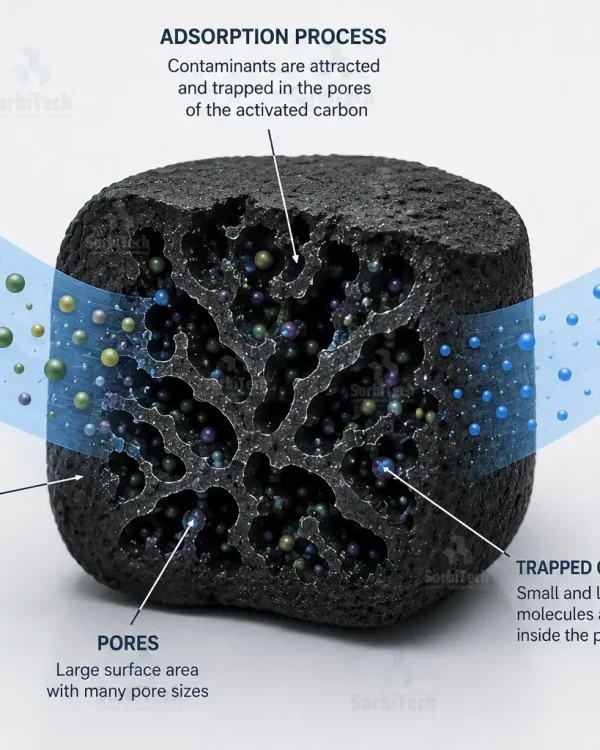
The adsorption mechanism itself is physical rather than chemical. Color, taste, and odor molecules are held inside the microporous and mesoporous structure of the carbon by van der Waals interactions, without any covalent bonding and without changing the pH or ionic profile of the surrounding liquid. Background technical detail on the pore structure and the adsorption process is set out in the guide on how activated carbon works.
How Activated Carbon Interacts With Edible Streams
The three main duties encountered inside a food and beverage plant have different color body chemistry and different plant hydraulics. The way activated carbon interacts with each is shaped by compound size, polarity, and process residence time. The role of activated carbons for sweeteners such as cane sugar, beet sugar, and glucose syrup, of edible oil activated carbon for seed oil polishing, and of coconut carbon media filters for the beverage industry in compact vessel installations, are all shaped by the same underlying pore chemistry described below.
Sugar and Sweetener Streams: Process Context
Raw and semi refined sugar solutions carry a mixture of caramels, melanoidins, and phenolic color bodies produced by Maillard chemistry during crystallisation and evaporation. These molecules span a wide size range, and the mesopore rich structure of chemically activated hardwood carbon reaches them more effectively than a purely microporous material. In practice, powdered activated carbon is dosed as an aqueous slurry into the affination or refining stage and separated with the filter cake once contact time has elapsed. Process integration and grade specification for the sugar decolorization process is documented on the sugar application page.
Edible Oil Streams: Process Context
Crude palm, soybean, sunflower, and rapeseed oils carry carotenoids, chlorophyll, oxidation products, and trace polycyclic aromatic hydrocarbons. Bleaching earth captures the bulk of the pigment load through adsorptive clay chemistry, and activated carbon adds a mesopore route to the larger residual color molecules and the PAH species that clay alone does not fully address. Grade specification and process integration for edible oil decolorization across the seed oil streams is documented on the edible oil application page.
Beverage Streams: Process Context
Beverage production runs from bottled water polishing through juice, coffee, tea, and the regional category of date and fruit syrups. The molecules of interest are smaller and often more volatile: chlorine and chloramines carried in from upstream water treatment, trace geosmin type compounds responsible for musty or earthy notes, and the taste and odor bodies that would otherwise carry into the finished drink. The high iodine number, high hardness profile of coconut shell granular activated carbon suits this duty in a continuous fixed bed vessel. Grade selection and process integration for activated carbon for the beverage industry is documented on the beverage application page.
Physical Properties That Shape Performance
Four physical and chemical properties determine how a food grade activated carbon behaves in a production stream. Each is measured under a standard laboratory method and reported on the certificate of analysis that accompanies every shipment.
| Property | What It Indicates | Typical Range |
|---|---|---|
| Iodine Number (mg/g) | Micropore adsorption capacity for small molecules | 850 to 1200 |
| Methylene Blue (mg/g) | Mesopore capacity for larger color bodies | above 180 |
| Ash content (%) | Residual mineral load, relevant to pH stability | below 5 |
| Hardness (%) | Mechanical resistance to attrition during backwash | above 95 for granular grades |
| Particle size or mesh | Hydraulics of the bed or filter cake recovery | 200 mesh (PAC), 8x30 or 12x40 (GAC) |
| pH of aqueous extract | Impact on treated liquid pH | 6 to 9 |
Iodine number tracks micropore surface area, which drives the removal of small molecules such as free chlorine, chloramines, and low molecular weight organics. Methylene blue tracks mesopore availability, which drives removal of larger color bodies typical of raw sugar, syrup, and edible oil. A high iodine number without matching methylene blue capacity leaves a carbon over specified for chlorine and under specified for color, and the reverse is also true. Some plants compare an activated carbon stage with ion exchange resin in sugar refining at this point in the specification exercise, since the two adsorbent chemistries target overlapping color body ranges through different mechanisms. Matching both to the target contaminant class is what delivers a stable operating profile through the service cycle.
Raw Material Origins
Food grade activated carbon reaches the market from three main raw material streams, and the choice of feedstock has a direct effect on the pore structure and residual mineral profile of the finished carbon.
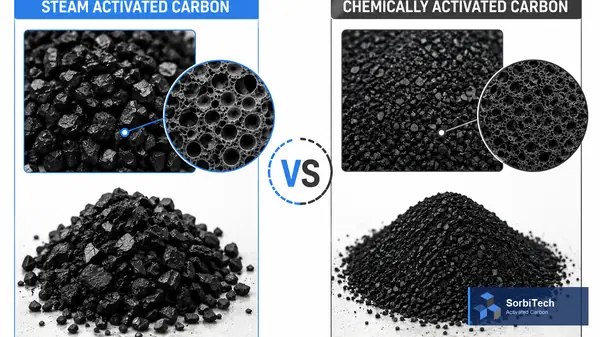
Coconut shell carbon delivers a predominantly microporous structure, high hardness, and low ash. It is produced through steam activation of shell char from mature coconuts, and it suits granular duty in beverage clarification and finished water polishing.
Wood based carbon is chemically activated using phosphoric acid, producing a mesopore rich material with high adsorption capacity for larger organic molecules. It is milled to a fine powder and used in sugar and edible oil decolorization streams.
Coal based carbon is produced through steam activation of bituminous or subbituminous coal. Its pore structure spans both micropores and mesopores, and it is chosen for streams with heavier organic loading such as raw juice or coffee polishing.
Regional Context Across the GCC
The GCC food and beverage sector operates a mix of large scale sugar refineries, edible oil hubs, and a growing beverage industry that spans bottled water, juice, coffee, tea, and date syrup production. Warehouse humidity, port to plant lead times, and the seasonal load pattern of the region shape how carbon is stored and reordered. Powdered material takes on moisture rapidly in humid coastal conditions and needs sealed packaging with low humidity storage to protect the specification through to the point of dosing. Granular material for beverage duty is often kept on a rolling replacement schedule aligned to the process throughput. Specific regional applications include soft drink flavor particle removal in bottling operations and turbidity removal from spirit in specialty distilled product lines.
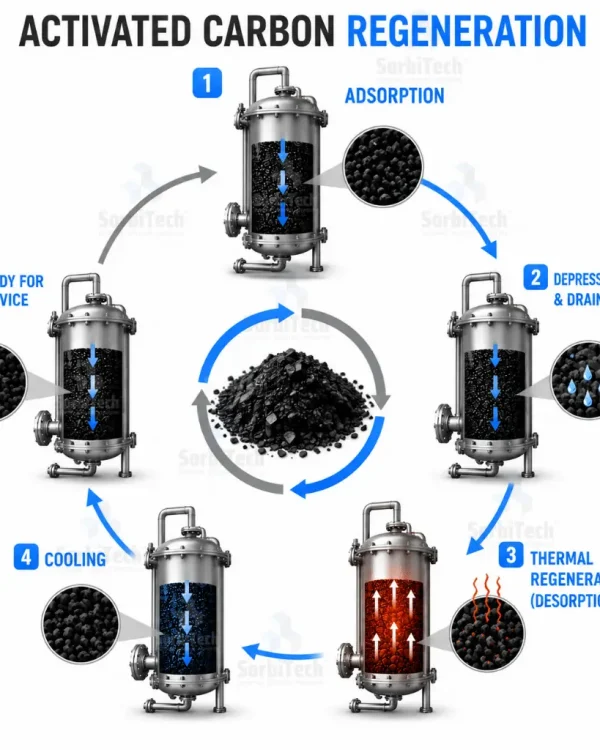
Spent granular carbon from beverage polishing is often eligible for thermal or steam regeneration, recovering a large fraction of the original adsorption capacity and reducing landed cost across successive cycles. Regeneration also lowers the environmental footprint of the treatment stage, which increasingly features in regional sustainability reporting.
Operational note. A carbon specified with a much higher iodine number than the process actually requires does not automatically produce a better result. In some streams, an over specified carbon also removes desirable flavour compounds alongside the target contaminants, and the finished product then reads as flat or characterless in sensory evaluation.
SorbiTech Group Portfolio
Activated Carbon Dubai operates as the regional arm of the SorbiTech™ Group, whose wider portfolio spans industrial adsorbent and separation systems covering water, gas, food, and process treatment programmes. The group also produces specialist adsorption chemistries through Medaad Adsorption Chemicals, whose adsorption chemistry portfolio sits alongside the activated carbon range for plants operating combined purification stages inside a single facility.
Technical enquiries for grade selection, dosing, or replacement scheduling across sugar, edible oil, and beverage duty can be raised through Contact Us.