Activated carbon industrial process water beds sit at multiple points inside a modern petrochemical facility, and they do a different job at each point. A granular carbon vessel ahead of the reverse osmosis skid removes free chlorine and organic foulants that would otherwise damage the membranes. A separate carbon bed on the boiler feed water train protects the demineraliser resin and the boiler tubes from trace hydrocarbons carried through the primary treatment stages. A polishing bed on the cooling tower blowdown catches biocide residuals and trace organics before the blowdown is discharged or reused. The three duties look superficially similar because all three involve granular activated carbon in a fixed bed vessel on a water line, but the grade, the bed geometry, and the replacement trigger differ measurably between them. The sections below cover the three main plant side water duties and how the specification changes across them. Municipal upstream context, where the raw water is produced before it reaches the plant fence line, is covered under municipal water treatment in the Middle East across desalination and distribution, and general water grade selection sits with activated carbon selection for water treatment across municipal and industrial duty.
Where Process Water Sits in a Petrochemical Plant
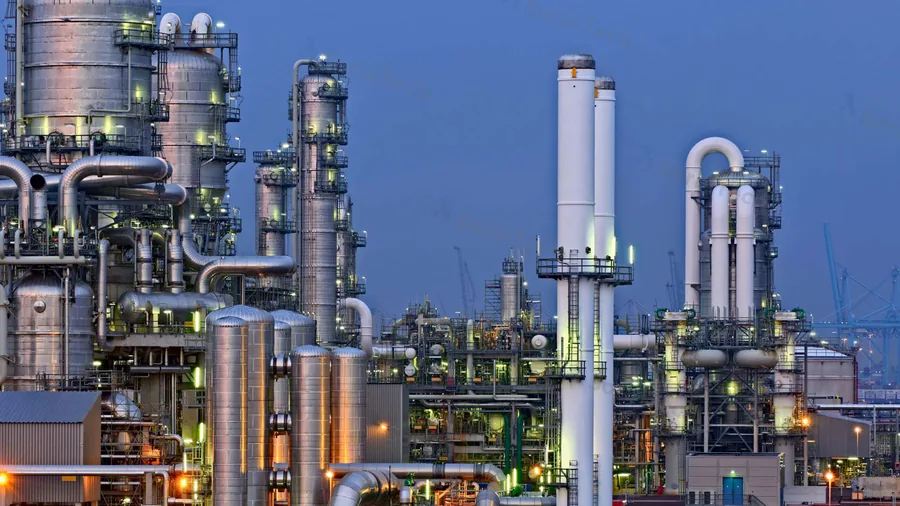
A petrochemical facility handles several distinct water streams. Raw water arrives from a municipal supply, from a desalination plant polishing stage that follows the reverse osmosis or thermal train, or from a mixed source that combines both. Inside the fence line, that raw water splits into a boiler feed water train that produces high pressure steam for the process reactors, a cooling water train that supplies the heat exchangers and cooling towers, a process water train that supplies wash water and reactor makeup to the units, and a potable water train that supplies the site accommodation. Each of these trains has a different chemistry specification, a different flow, and a different tolerance for trace contaminants. Activated carbon appears somewhere in almost every one of them, but the grade and the position of the bed depend on the specific duty.
The plant side water treatment stages sit downstream of any municipal or desalination plant that produced the raw water in the first place. This means the load on the plant side carbon bed is generally lower than the load on the municipal side bed. The plant side bed is doing a polishing job on water that has already been treated to a reasonable specification, not a bulk removal job on raw source water. The bed geometry, the working capacity assumptions, and the replacement schedule all reflect that difference.
Dechlorination Before Reverse Osmosis Membranes
Reverse osmosis membranes are chemically sensitive to free chlorine. Polyamide membranes, which are the dominant type in modern reverse osmosis installations, oxidise progressively when exposed to chlorine at concentrations above around 0.1 milligrams per litre. The oxidation shortens membrane life measurably, produces increased salt passage, and eventually requires replacement of the membrane element. The upstream water treatment stages, particularly at municipal sources, typically carry a chlorine residual of 0.5 to 1.5 milligrams per litre for microbiological protection in drinking water distribution. A dechlorination stage between the incoming water and the reverse osmosis skid is therefore an almost universal requirement.
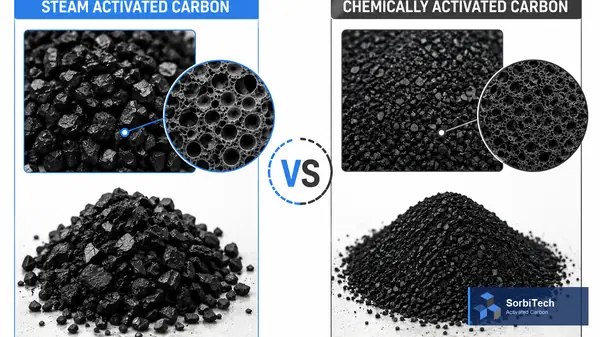
Activated carbon is the standard technology for dechlorination in petrochemical process water installations. A granular coconut shell bed sitting ahead of the reverse osmosis skid catalytically reduces free chlorine to chloride, holding the membrane inlet consistently below the manufacturer's threshold. Empty bed contact time for dechlorination duty typically sits between 5 and 10 minutes, superficial velocity between 5 and 15 metres per hour, and bed depth between 1 and 2 metres. Coconut shell base carbon is preferred because it has both the mechanical strength for backwash cycles and the low ash profile that avoids releasing fines into the downstream process. Coconut shell base carbon in 12 by 40 or 8 by 30 mesh is the standard grade for this duty, held in stock at the Dubai and Sohar service centres.
Organics Removal for Boiler Feed Water Protection
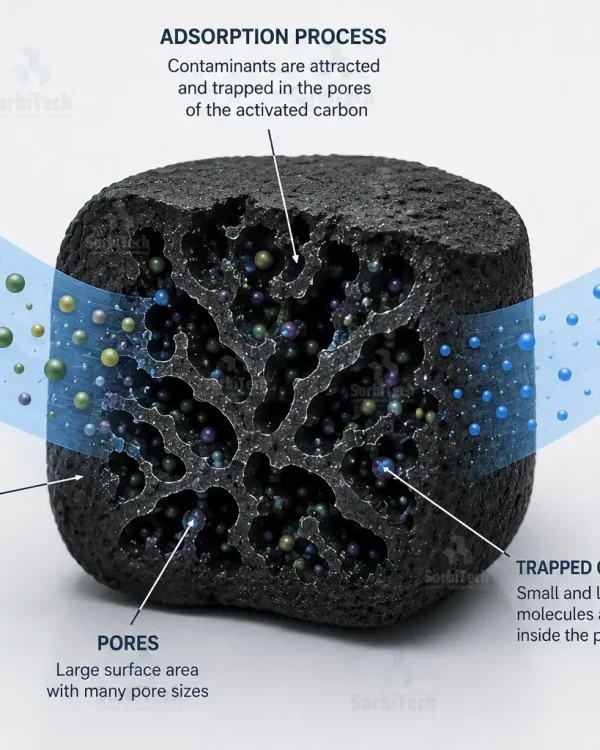
Boiler feed water systems in a petrochemical plant operate at high pressure and high temperature, and they are exquisitely sensitive to trace organic loading. Organic species in the feed water break down under boiler conditions to produce carbon dioxide, weak organic acids, and various oxidation products, which then produce corrosion in the condensate return system, foaming in the boiler drum, and carryover into the steam supply. The demineraliser resin that follows the primary treatment is expensive and sensitive to organic fouling. An activated carbon bed sitting ahead of the demineraliser catches the trace organic load and extends the resin regeneration cycle measurably.
The grade specification for this duty leans on a slightly broader pore distribution than dechlorination. A coconut shell base carbon still dominates, but a coal based activated carbon with its broader pore distribution is often preferred where the raw water carries a higher humic acid load or where the plant source water shows seasonal variation in the organic profile. Bed geometry for boiler feed protection is broadly similar to dechlorination, though contact time is often extended to the upper end of the range to give the bed more residence time on the harder to remove humic species.
Trace Hydrocarbon Removal from Cooling Loops
Cooling water loops in petrochemical facilities are exposed to leaks from heat exchangers on the process side. Even a small heat exchanger tube leak allows process hydrocarbons to enter the cooling water and, over time, accumulate to concentrations that produce microbial fouling in the cooling tower, corrode the tube metallurgy, and produce a hydrocarbon signature in the blowdown that has to be either treated or paid for as a discharge penalty. An activated carbon polishing bed on either the cooling water side stream or the blowdown line catches the accumulated hydrocarbon load and either restores the cooling water quality or produces a discharge compliant blowdown stream.
The grade selection for this duty depends on the hydrocarbon mix. A coconut shell coal blend, or a straight coal based grade with broader pore distribution, is preferred for the mixed hydrocarbon load typical of a leaking cooling loop. Bed geometry is similar to dechlorination but with a longer contact time, typically 10 to 20 minutes, to accommodate the harder to remove mid molecular weight species. Replacement is triggered by outlet total organic carbon rise rather than by pressure drop, since the loading pattern is variable and the total mass loading before breakthrough is generally larger than the mass loading that produces pressure drop from particulates.
Media Replacement in Continuous Industrial Service
Bed replacement scheduling in continuous petrochemical service typically works to one of three triggers: elapsed operating time, upstream contaminant loading, or downstream outlet monitoring. Elapsed time replacement suits stable feeds where the loading pattern is predictable and the bed life is well characterised from historical operation. Loading based replacement suits variable feeds where the actual load cycle depends on upstream events. Outlet based replacement suits duties where the bed is expected to protect a sensitive downstream unit (RO membranes, demineraliser resin) and the plant operator prefers to see the actual outlet quality rather than trust a time or loading prediction.
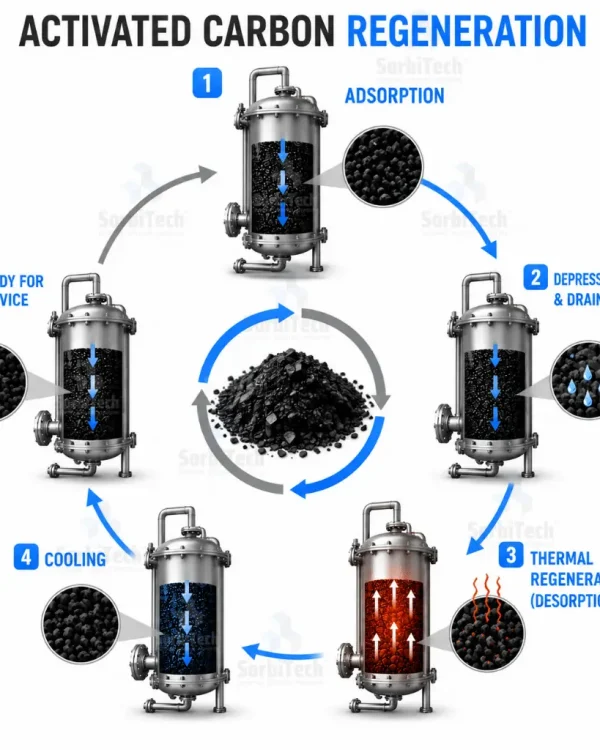
In practice, most petrochemical operators use a combination approach: a maximum time between replacements to protect against unnoticed capacity loss, with an earlier replacement trigger if the outlet monitoring or upstream loading indicates the bed is approaching breakthrough. Spent carbon from these duties is generally suitable for thermal reactivation of the spent carbon. Reactivated grade material returns to the plant at lower cost than virgin, and the cost saving typically justifies the logistics of segregated collection and shipment to a reactivation facility.
Sohar, Ruwais, Jubail: Shared Operating Envelope
The three major petrochemical clusters in the eastern Gulf share a broadly similar operating envelope for process water treatment. Sohar in Oman, Ruwais in the UAE, and Jubail in Saudi Arabia all combine desalination sourced raw water with a mix of thermal and reverse osmosis stages, both of which benefit from activated carbon polishing. Site specific factors vary: the salinity of the source water, the ambient temperature range, the plant footprint available for treatment equipment, and the specific downstream units being protected. Regional supply into these clusters from activated carbon supply into Sohar and the equivalent supply chains into Ruwais and Jubail supports both scheduled replacement and unscheduled bed changeouts across the three sites.
Vessel specification and grade selection detail for each of the duties described above sit alongside industrial process water treatment across the plant water train, and the standard specifications for the coconut shell and coal based grades sit under granular activated carbon for fixed bed vessels.
Operating note. The most common cause of unexpectedly short bed life on a petrochemical process water installation is not the primary contaminant load but an intermittent upstream event that the design did not anticipate. A shock chlorine dose from the municipal source, a heat exchanger tube leak that produced a hydrocarbon slug, or a filter breakthrough that sent particulate load to the carbon bed will all shorten bed life without producing an obvious symptom until the next scheduled replacement reveals reduced capacity. Data logging of the upstream conditions, alongside the outlet trend, is the reliable way to distinguish predictable ageing from event driven capacity loss.
SorbiTech Group Portfolio
Activated Carbon Dubai supplies coconut shell and coal based granular grades for petrochemical process water duty across the wider Gulf under the SorbiTech™ Group portfolio. Standard 12 by 40 and 8 by 30 mesh grades are held in stock at the Dubai and Sohar service centres, supporting both scheduled turnaround loadings and unscheduled bed replacements. The wider industrial adsorbent portfolio covers adjacent gas treatment and specialty duties, complemented by Medaad Adsorption Chemicals for combined purification installations.
Technical enquiries for activated carbon industrial process water grade selection, bed sizing for a specific duty, or replacement scheduling across a plant water treatment train can be raised through Contact Us.