Activated carbon quietly sits inside almost every large desalination plant in Saudi Arabia, doing the work that keeps the finished water safe to drink and safe to release into industrial process trains. The visible engineering in a seawater reverse osmosis plant is the pump gallery, the pressure vessels, and the energy recovery devices. The invisible engineering is the pretreatment train that protects the membranes from free chlorine and organics, and the polishing train that catches the low molecular weight taste and odour compounds that slip past the membrane. Activated carbon is the media that carries both duties. For the Saudi utilities and industrial groups that are scaling desalination capacity under Vision 2030 and pushing hard on water reuse for landscaping, industrial cooling, and agricultural supply, the specification of the activated carbon inside those trains is a quiet but load bearing decision. The wider commercial and technical context for Saudi Arabia specific supply, grade catalogue, and delivery lanes lives at activated carbon supply into Saudi Arabia. Broader treatment placement across desalination systems sits at activated carbon for desalination and seawater treatment.
Where Activated Carbon Fits in a Saudi SWRO Train
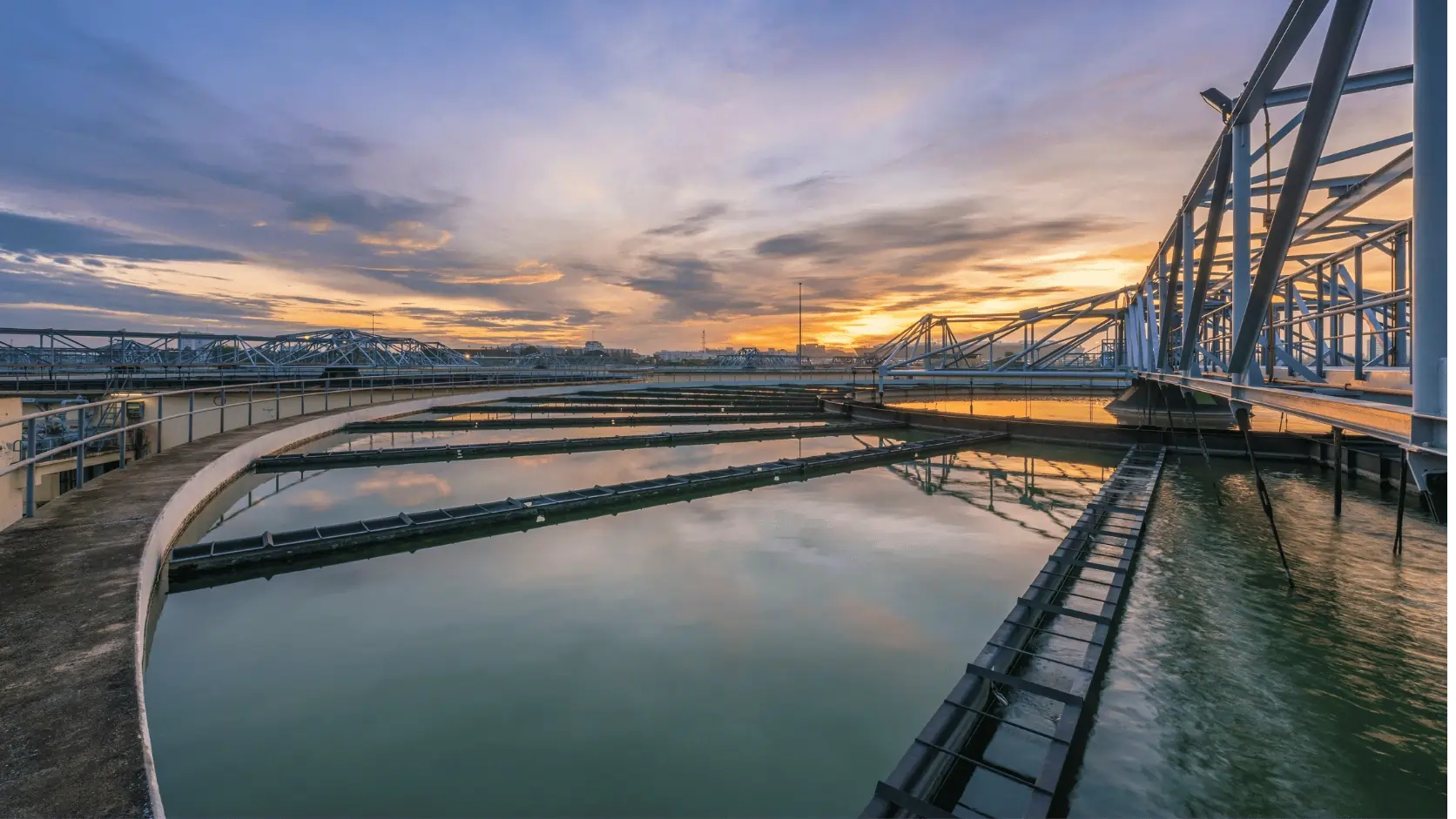
A modern seawater reverse osmosis train in the Gulf follows a broadly consistent order. Raw seawater passes through a screening and coagulation stage, then through dissolved air flotation or coarse media filtration, then through a fine media or ultrafiltration stage that removes suspended solids and colloids. The pretreated water then meets the reverse osmosis membrane bank at a working pressure of 60 to 80 bar. The permeate that leaves the membrane bank is very low in salts but is not yet finished water. It still carries residual dissolved organics, dissolved gases, and trace disinfectant that the membrane did not reject. That permeate then enters a polishing stage where activated carbon, remineralisation, and final disinfection prepare the water for delivery.
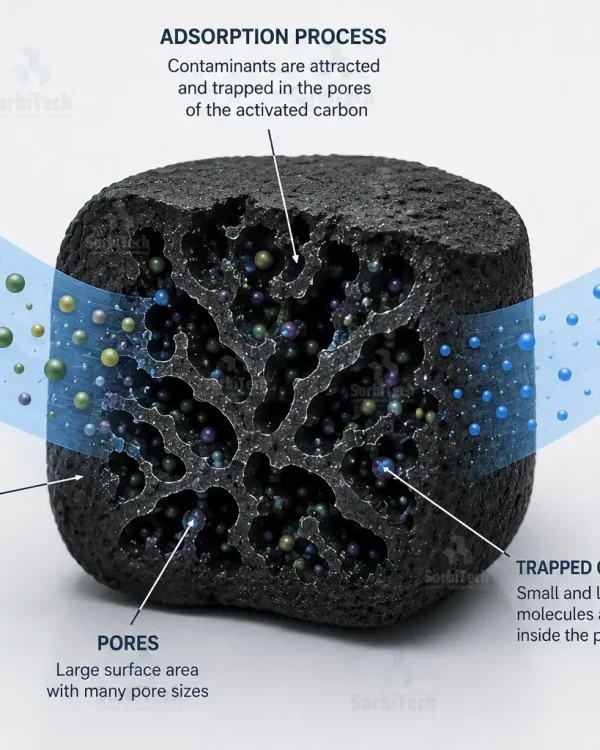
Activated carbon appears at two distinct places in this sequence. On the front side of the membrane bank, granular activated carbon beds sit between the fine filtration stage and the reverse osmosis feed pumps, catching residual free chlorine and residual oxidant from the seawater intake chemistry. On the back side of the membrane bank, granular activated carbon beds sit between the reverse osmosis permeate and the delivery tanks, catching low molecular weight organics that slipped through the membrane and the trace taste and odour compounds that the finished water would otherwise carry to the consumer tap.
Polishing SWRO Permeate for Taste, Odour, and Residual Organics
The taste and odour issue in Saudi finished water is not a hypothetical concern. Warm surface seawater in the Arabian Gulf and the Red Sea carries an active phytoplankton and cyanobacteria load through much of the year, and the metabolic byproducts of these organisms include geosmin and 2 methylisoborneol, the two compounds that produce the muddy, earthy taste that consumers immediately notice. Reverse osmosis rejects most of these compounds but not all. Trace concentrations in the low nanograms per litre range are enough to trigger consumer complaint, because the human palate detects both compounds at concentrations well below one part per billion.
Granular activated carbon polishing on the permeate side captures both compounds efficiently at typical desalination flow conditions. The working parameters for a permeate polishing bed are an empty bed contact time of 8 to 15 minutes, a bed depth of 1.8 to 2.4 metres, and a service velocity of 8 to 12 metres per hour. The base carbon for permeate polishing duty is almost always coconut shell base carbon, because its pore structure is dominated by the small micropores where geosmin and 2 methylisoborneol are captured most effectively, and because its hardness allows repeated backwashing without generating fines that would carry over into the finished water. Coal based carbon can be used for cost sensitive installations but its wider mesopore fraction shifts capture efficiency for the two nuisance compounds slightly downward. Broader base carbon selection background against water treatment duty sits at activated carbon selection for water treatment applications.
Dechlorination Before the RO Membrane Bank
Seawater intake chemistry in Saudi desalination plants includes shock chlorination to control biofouling on the intake pipes and the coarse screens. Sodium hypochlorite or on site electrochlorination generates a residual free chlorine concentration of 1 to 3 milligrams per litre in the raw seawater entering the pretreatment train. That free chlorine has to be removed before the water reaches the reverse osmosis membrane bank, because polyamide reverse osmosis membranes suffer irreversible oxidation damage at free chlorine concentrations above 0.1 milligrams per litre. The traditional approach is sodium metabisulphite injection ahead of the membrane bank, which chemically neutralises the free chlorine.
Granular activated carbon dechlorination is the alternative to chemical dosing and is preferred in installations where the operator wants to eliminate the metabisulphite storage and dosing infrastructure or where the plant sits at a remote intake location. The dechlorination reaction on activated carbon is catalytic. The carbon surface converts free chlorine to chloride ion and adsorbs the reaction products. A coconut shell or coal based granular carbon with high iodine number and 12 by 40 mesh sizing handles seawater dechlorination duty at empty bed contact times of 3 to 5 minutes and service velocities of 15 to 20 metres per hour. The bed operates for years before the catalytic activity begins to decline, and the endpoint is set by a slow rise in free chlorine breakthrough rather than by pressure drop or capacity loss.
Activated Carbon Grade Selection for Saudi Desalination Duty
Grade selection for Saudi desalination service turns on three parameters that the specifying engineer needs to hold in front of them: base material, iodine number, and mesh size. The base material sets the pore structure and the mechanical strength. The iodine number sets the working capacity. The mesh size sets the pressure drop and the backwash behaviour. The following table summarises the typical grade specification for the main carbon duty points in a Saudi seawater desalination train and in the associated water reuse trains that feed industrial and landscape supply.
| Duty point | Base material | Iodine number | Mesh size | EBCT | Service velocity |
|---|---|---|---|---|---|
| Dechlorination before RO | Coconut shell or coal | 900 to 1100 mg per g | 12 by 40 | 3 to 5 min | 15 to 20 m per hour |
| Permeate polishing | Coconut shell | 1000 to 1200 mg per g | 12 by 40 or 8 by 30 | 8 to 15 min | 8 to 12 m per hour |
| Chloramine reduction | Catalytic coal based | 900 to 1050 mg per g | 12 by 40 | 15 to 25 min | 8 to 12 m per hour |
| Reuse tertiary polishing | Coal or coconut shell | 900 to 1100 mg per g | 8 by 30 | 15 to 25 min | 8 to 10 m per hour |
For plants that use monochloramine rather than free chlorine as the intake disinfectant, the catalytic dechlorination duty shifts to a chloramine reduction duty, which requires a modified base carbon with a higher active site density. Chloramine reduction on standard granular carbon proceeds at roughly one third of the free chlorine reduction rate, so the empty bed contact time in a chloramine reduction bed doubles or triples compared to a free chlorine reduction bed of the same throughput. The mechanism of activated carbon filtration and catalytic conversion gives the full background on this behaviour.
Water Reuse and Tertiary Treatment for Industrial Supply
Saudi Arabia is pushing hard on higher rates of treated sewage effluent reuse for industrial cooling, landscape irrigation, and agricultural supply. That push moves activated carbon out of the desalination train and into the tertiary treatment stage of municipal wastewater plants. Reuse water typically leaves a secondary biological treatment stage carrying dissolved organics, colour, and trace pharmaceutical residues that make it unsuitable for direct industrial use even though the bulk parameters look acceptable. A polishing stage using granular activated carbon after the secondary clarifier or after a membrane bioreactor step brings the finished reuse water within the specification for direct industrial cooling tower makeup, boiler feed after final ion exchange, and unrestricted landscape irrigation.
The activated carbon duty in the reuse train differs from the desalination polishing duty in two respects. The organic load is higher, so the working capacity is exhausted faster and the bed replacement cycle is shorter, typically 12 to 24 months rather than the 3 to 5 years typical for seawater permeate polishing. The bed sizing follows an empty bed contact time of 15 to 25 minutes rather than the tighter 8 to 15 minutes of a permeate polisher. Spent carbon from reuse polishing beds is a strong candidate for thermal reactivation of spent carbon in a rotary or multiple hearth kiln, because the loading is dominated by adsorbed organic compounds that decompose cleanly at reactivation temperatures. The wider treatment context for reuse and municipal supply across the region sits with activated carbon in Middle East municipal water treatment and with activated carbon in industrial and municipal wastewater treatment.
Design observation. The single most common oversight in specifying activated carbon for a Saudi desalination polishing bed is treating the base carbon as a commodity. Two carbons with the same iodine number can differ by a factor of two in their working capacity against geosmin and 2 methylisoborneol, because iodine number tracks the total surface area while the two nuisance compounds are captured only in the small micropore fraction. Coconut shell base carbon consistently outperforms coal base carbon at the same iodine number in this duty, and the difference is worth the modest premium at the specification stage.
Industrial Process Water Duty at Saudi Heavy Industrial Sites
Beyond the municipal water sector, Saudi Arabia's petrochemical, refining, and power generation clusters at Jubail, Yanbu, Rabigh, and Ras Al Khair all operate large activated carbon polishing beds on process water streams. These beds sit between the desalinated raw water supply and the point of use inside the process plant, catching residual organics, colour, and any trace hydrocarbon carryover from upstream separation stages. The grade specification tracks the municipal polishing grade closely, but the bed sizing is larger because the throughput per point of use is typically higher inside a heavy industrial facility than inside a municipal distribution train. The application background for this duty group sits with activated carbon for industrial process water treatment.
Regulatory and Quality Framework in the Saudi Water Sector
The Saudi Standards, Metrology and Quality Organization publishes the finished potable water specification that all municipal supply must meet, and the specification is broadly aligned with the World Health Organization drinking water guidelines. The activated carbon polishing stage in a Saudi desalination train is designed against these specifications, with particular attention to the taste, odour, and organic residue targets that the raw permeate would otherwise fail. Certified activated carbon media for municipal use in Saudi Arabia has to carry a food and water contact certification from an internationally recognised body, typically NSF ANSI 61 for direct water contact. Media supplied without this certification cannot be used inside a municipal potable train.
The GCC Standardization Organization publishes overlapping specifications that apply across the wider Gulf Cooperation Council market. For an activated carbon supplier serving Saudi municipal and industrial customers, holding both the Saudi and the wider GCC certifications on the same product allows the same batch to move across the region without a fresh compliance step at each border. Reuse water for agricultural or landscape irrigation in Saudi Arabia falls under a separate specification that sets discharge limits on residual disinfectant, biological oxygen demand, and heavy metals; the polishing stage on the reuse train has to be designed against that specification rather than against the potable specification, and the grade selection differs accordingly.
Logistics and Delivery into Saudi Arabia
Activated carbon media for Saudi desalination and reuse installations moves through two main logistics lanes. The primary lane runs from the Jebel Ali port complex in Dubai to the Dammam eastern seaboard port, and from there overland to the eastern industrial belt and to the interior. The secondary lane runs from Jebel Ali through the Batinah coast of Oman across the Al Bathaa border to the interior, or through the Salwa border to the eastern belt. For the western industrial belt including Jeddah, Yanbu, and Rabigh, direct sea freight to Jeddah Islamic Port is the primary lane, with land routes to Riyadh handling interior distribution.
Delivery lead times from a Jebel Ali warehouse to a Saudi site are typically 5 to 7 working days for eastern belt destinations and 7 to 10 working days for western belt destinations. Packaging for Saudi delivery is typically 25 kilogram polypropylene laminated bags for smaller quantities, 500 kilogram jumbo bags for mid range volumes, and 20 tonne bulk bags for large project loads. Delivery documentation includes the certificate of analysis for each batch, the food and water contact certification, and the required Saudi customs paperwork. Larger project volumes are typically shipped as full container loads on a defined delivery schedule tied to the project construction phasing. The full commercial and logistical framework for Saudi supply, including delivery lanes and Incoterms, is set out at the Saudi Arabia supply catalogue.
Impregnated and Specialist Grades for Saudi Water Duty
Standard granular carbon covers the base dechlorination and polishing duty in a Saudi desalination train, but three specialist grades appear in specific applications. Silver impregnated activated carbon is used in point of use polishing where downstream microbial regrowth on the bed itself needs to be suppressed, typically in remote or off grid installations where the finished water sits in storage for extended periods. Powdered activated carbon dosing ahead of the clarifier stage is used seasonally in plants that face intermittent algal bloom driven taste and odour spikes, where the fixed granular bed on the polishing stage cannot handle the load alone. Extruded pellet grade carbon is used in gas phase odour control on the sludge and biosolids handling side of a municipal wastewater plant, particularly at reuse plants where the sludge handling area sits close to residential or commercial development. The wider application coverage for these grades in drinking water and reuse trains sits at activated carbon for drinking water treatment.
SorbiTech Group Portfolio
Activated Carbon Dubai supplies coconut shell, coal based, and impregnated activated carbon grades into Saudi desalination and water reuse installations under the SorbiTech™ Group portfolio. Standard duty grades are stocked in granular carbon for water treatment in 8 by 30 and 12 by 40 mesh sizings, alongside impregnated grades for point of use polishing and powdered grades for seasonal taste and odour dosing. The wider industrial adsorbent portfolio covers process water polishing, air phase odour control on sludge handling, and adjacent duties across the Saudi industrial water sector, complemented by Medaad Adsorption Chemicals for coagulant and pretreatment chemistry.
Technical enquiries for Saudi desalination grade selection, permeate polisher bed sizing, or dechlorination duty analysis can be raised through Contact Us. The wider Saudi supply catalogue, delivery lanes, and commercial framework sit at activated carbon supplier in Saudi Arabia.