Reliable Adsorption Technology for PFAS Removal
PFAS, the family of perfluoroalkyl and polyfluoroalkyl substances including PFOA, PFOS, GenX, PFBS and PFHxA, are known as forever chemicals because the carbon fluorine bond resists chemical, thermal and biological breakdown. Removal from drinking water, groundwater, industrial process water and effluent requires a technology that captures PFAS on a solid phase and holds it there. Activated carbon delivers that capture reliably at the parts per trillion concentrations where PFAS treatment is required. SorbiTech Group, a global activated carbon manufacturer, supplies granular, powdered and impregnated activated carbon engineered for PFAS adsorption duty worldwide, including the UAE, Saudi Arabia, Qatar, Kuwait, Oman and Bahrain.
Adsorption Mechanism of PFAS onto Activated Carbon
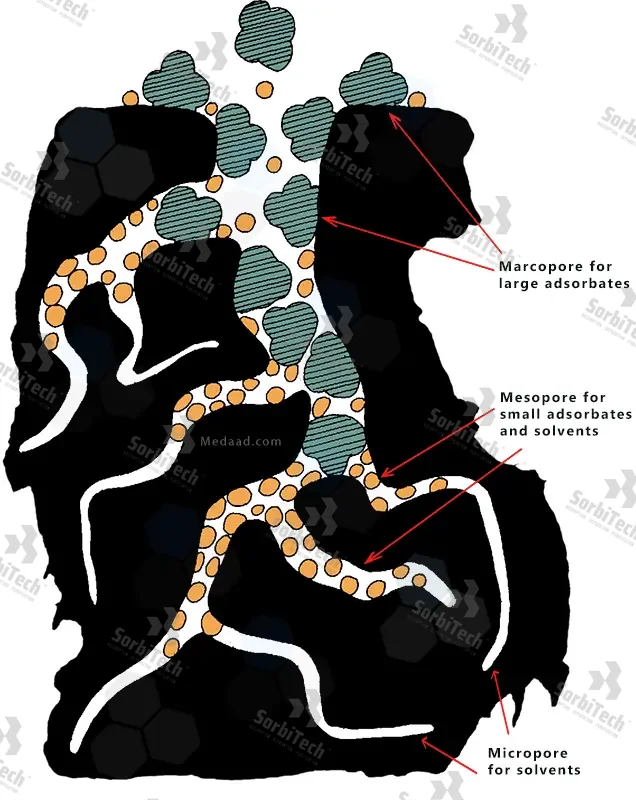
PFAS molecules carry a fluorinated carbon tail that is strongly hydrophobic and a polar head group. In water, the hydrophobic tail is driven onto any non polar surface that offers refuge from the aqueous phase. The internal surface of an activated carbon granule, with its engineered pore network, provides exactly that surface. PFAS binds through hydrophobic adsorption and van der Waals interactions, with no chemical dosing and no energy input beyond the pressure drop across the bed.
Long chain PFAS such as PFOA and PFOS anchor firmly in the mesopore range, where the larger fluorinated tail delivers a strong hydrophobic driving force. Short chain PFAS such as GenX, PFBS and PFHxA carry smaller tails and more polar character; the hydrophobic driving force is weaker and bare carbon captures them with lower efficiency. For short chain dominated streams, impregnated activated carbon introduces polar surface sites that lift short chain uptake materially.
Natural organic matter and competing dissolved organics occupy adsorption sites alongside PFAS. Grade selection and bed sizing account for this competition so that the specified bed life is representative of the actual water, not a clean laboratory baseline.
PFAS Treatment Configurations
Fixed Bed Granular Activated Carbon
Fixed bed granular activated carbon is the standard configuration for continuous PFAS treatment. Water passes downward through a packed carbon bed held inside a pressure vessel. A lead and lag arrangement, with two vessels in series, is specified for PFAS service: the lead bed carries the full PFAS load while the lag bed acts as a barrier against breakthrough. Intermediate sampling confirms the operating position at any time. Fixed bed GAC covers drinking water treatment, groundwater remediation and industrial process water duty.
Powdered Activated Carbon Dosing
Powdered activated carbon is dosed directly into mixed water for rapid uptake of PFAS peaks and seasonal spikes. The configuration suits conventional water treatment trains where coagulation, clarification or sand filtration already handles the solids separation downstream. Dose rate is adjustable in real time, which is useful where PFAS concentration varies with source conditions.
Impregnated Carbon Polishing
Impregnated activated carbon carries a polar active phase bonded onto the carbon surface. It is specified as a polishing stage downstream of standard GAC where the influent carries a significant short chain PFAS load (GenX, PFBS, PFHxA) that standard adsorption does not capture efficiently. The impregnation chemistry underlying this configuration is set out in the impregnated activated carbon chemistry reference.
Spent Carbon Management
PFAS captured on activated carbon remains on the solid phase. Spent media is removed from service and routed to thermal reactivation at licensed facilities, where temperatures sufficient to break the carbon fluorine bond are maintained and the PFAS is destroyed in controlled off gas treatment. Where reactivation is not appropriate, dedicated high temperature incineration provides an alternative destruction route. The underlying thermal process is covered in the activated carbon regeneration reference.
Selecting Activated Carbon for PFAS Removal
PFAS performance of an activated carbon is driven by three factors: raw material and activation route, pore size distribution, and surface chemistry. Bituminous coal based granular activated carbon offers a broad mesopore structure well matched to long chain PFAS and is the standard specification for drinking water, groundwater and industrial process water duty. Coconut shell granular activated carbon offers a micropore dominated structure useful where attrition resistance and dust control are important. Impregnated activated carbon adds polar sites targeted at short chain PFAS.
Grade selection follows the PFAS fingerprint on the influent, the background organic load, the required outlet concentration and the existing vessel geometry. Pilot column testing on actual site water validates the selection and generates a defensible breakthrough curve before the full charge is specified.
SorbiTech Activated Carbon for PFAS Removal
SorbiTech supplies three product families routinely deployed on PFAS adsorption duty: bituminous coal and coconut shell granular activated carbon for fixed bed service, powdered activated carbon for direct dosing, and impregnated activated carbon for short chain polishing. Each grade is matched to a specific role in the treatment configuration above.
Supply covers grade recommendation on the project PFAS fingerprint, pilot column study on actual site water, system sizing covering bed depth, empty bed contact time and vessel configuration, and lifecycle management of the spent media through thermal reactivation or dedicated destruction. The selection methodology is set out in the water treatment activated carbon selection reference.
Industrial Activated Carbon for PFAS Treatment in the Gulf
SorbiTech Group manufactures and supplies activated carbon media for water treatment and industrial purification worldwide. Regional supply covers the UAE, Saudi Arabia, Qatar, Kuwait, Oman and Bahrain. PFAS removal projects are supported with grade recommendation on the site PFAS fingerprint, pilot column verification on actual site water, system sizing and lifecycle management of the spent media through thermal reactivation or dedicated destruction.
Discuss Your PFAS ProjectFrequently Asked Questions
Which activated carbon grade is specified for PFOA and PFOS in drinking water?
Bituminous coal based granular activated carbon is the standard specification for PFOA and PFOS in municipal drinking water duty. The grade is installed in a fixed bed pressure vessel, usually in a lead and lag configuration, with sampling between vessels to monitor the operating position.
How are short chain PFAS such as GenX, PFBS and PFHxA treated?
Short chain PFAS carry smaller fluorinated tails and more polar character, so standard granular activated carbon captures them less efficiently than long chain PFAS. For short chain dominated streams, impregnated activated carbon is specified as a polishing stage downstream of standard GAC. The impregnated grade adds polar surface sites that improve short chain uptake.
Can activated carbon be combined with reverse osmosis for PFAS?
Yes. Granular activated carbon placed upstream of reverse osmosis reduces PFAS loading and organic fouling on the membrane. The combined configuration is specified where the target outlet concentration is very low and where salinity reduction or water reuse is also required.
How is spent activated carbon handled after PFAS adsorption?
Spent carbon is routed to thermal reactivation at licensed facilities operating at temperatures sufficient to break the carbon fluorine bond. PFAS is destroyed in controlled off gas treatment and the reactivated media returns to service. Where reactivation is not appropriate, dedicated high temperature incineration provides an alternative destruction route.
Is pilot testing required before specifying a PFAS system?
Pilot column testing on actual site water is strongly recommended for PFAS applications because background organics, temperature and PFAS fingerprint all influence bed life. The pilot generates a breakthrough curve that supports grade selection, empty bed contact time and bed depth and lets the final specification stand on measured data rather than theoretical isotherms.
Can activated carbon be used in industrial wastewater service for PFAS?
Yes. Granular activated carbon in a lead and lag configuration is specified as a polishing stage for industrial wastewater streams carrying PFAS. The configuration sits downstream of biological or membrane pretreatment that removes solids and organic load.